
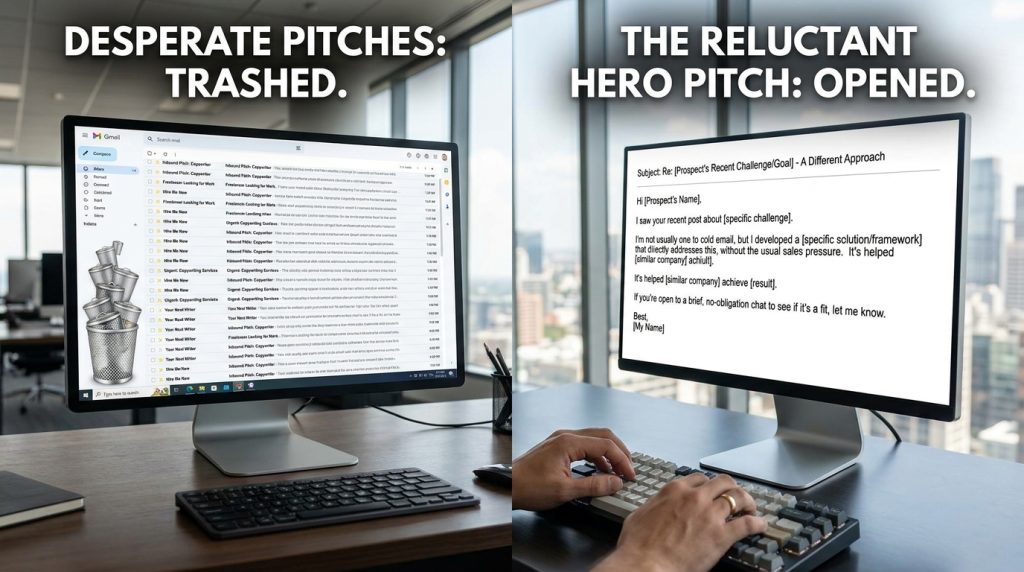

Most freelance copywriting pitches end up in the trash because they reek of desperation. Founders and marketing directors at companies like Loom, Vanta, or Ghost open their inboxes to dozens of emails starting with “I am a freelance copywriter looking for new clients.”
That approach guarantees failure. The moment you ask for work, you signal low status. You become a vendor begging for a handout. The open rates for standard pitches flatline below 15%, and positive response rates hover around an abysmal 0.2%.
To bypass the spam filters in a prospect’s brain, you have to flip the script. You stop being the eager vendor and become the “Reluctant Hero.” You position yourself as a highly booked, unavailable specialist who was compelled to reach out solely because of the prospect’s specific, undeniable mission. You don’t need their money; you are simply intrigued by their problem.
The Psychology of the Anti-Pitch
The standard cold email assumes the freelancer is the one with the deficit. The Reluctant Hero pitch operates on the principle of artificial scarcity. People want what they cannot easily have. When you immediately disqualify yourself from needing the work, the prospect drops their defensive guard.
Instead of evaluating you as an expense, they evaluate you as an exclusive asset.
Here is how the baseline metrics shift when moving from a standard pitch to a Reluctant Hero framework:
| Metric | Standard “Eager” Pitch | The Reluctant Hero Anti-Pitch |
| Open Rate | 12% – 15% | 40% – 55% |
| Response Rate | < 0.5% | 3% – 6% |
| Sales Call Conversion | 10% | 35% |
| Perceived Status | Vendor (Commodity) | Peer (Specialist) |
The numbers shift drastically because the Reluctant Hero pitch exploits a psychological loophole: cognitive dissonance. The prospect expects a sales pitch. Instead, they receive a message from someone saying, “I’m not looking for work right now, but your project is so interesting I had to step in.” This breaks their expected pattern.
Core Elements of the Reluctant Hero Strategy
You cannot just say “I’m busy.” That sounds arrogant. The structure requires a specific balance of unavailability and deep, personalized interest.

1. The Disarming Subject Line
Your subject line must not sound like a marketing agency. It should look like an internal memo or a brief thought from a colleague. Capitalize it like a normal person sending a quick note.
- Bad: “Boost Your Conversion Rates with Expert Copywriting!”
- Good: “quick question about your Q3 messaging”
- Good: “loved the recent pivot (and a quick thought)”
- Good: “your landing page for [Feature]”
2. The Scarcity Opener
Address the reality immediately. Tell them you are not actively hunting for clients. This lowers their defense mechanisms instantly.
3. The Specific Mission Alignment
This is the hardest part. You must prove you actually looked at their business. If you are pitching a B2B SaaS company like Linear, you cannot vaguely praise their “great software.” You have to point out a specific shift in their product roadmap, a recent funding round, or a specific angle in their recent content marketing. You are reaching out because this specific thing caught your eye.
4. The Unsolicited Proof of Work
Since you are the Reluctant Hero, you do not ask for permission to audit their copy. You just give them a tiny, highly valuable piece of insight for free, proving your competence without demanding a meeting.
5. The Low-Friction, Walk-Away Ask
You do not end with a Calendly link. You end with a soft question that allows them to reply with a simple “yes” or “no.” You make it clear that if they say no, you are perfectly fine walking away.
The Exact Execution Templates
Here are the specific assets. Do not copy them verbatim without injecting the actual research you do on the prospect.
Template 1: The B2B SaaS “Roadmap” Pitch
Use this when a company has just launched a new feature, acquired a competitor, or shifted their target audience.
Subject: the new [Feature Name] launch
Hi [First Name],
I’ll keep this brief. I’m currently fully booked for Q2 and not actively taking on new freelance clients right now.
But I saw [Company Name]’s announcement about shifting toward [Specific Industry/Feature] yesterday, and it caught my attention. I specialize in writing conversion copy for [Your Niche], and I know how hard it is to nail the messaging when pivoting upmarket.
I noticed your current landing page for [Feature Name] focuses heavily on [Current Weak Angle]. Since your new target audience cares much more about [New Strong Angle], I actually rewrote your hero section and the first three benefit blocks this morning over coffee.
I don’t expect anything in return, just thought you might find it useful for A/B testing. Mind if I send the Google Doc over?
Best,
[Your Name]
Template 2: The D2C E-commerce “Tear Down” Pitch
Use this for physical product brands that are running heavy paid social ads but have leaky email funnels.
Subject: your current welcome sequence
Hey [First Name],
I normally don’t do cold outreach anymore since my client roster is full, but your recent ad campaign for [Specific Product] has been following me around the internet for a week. The creative is brilliant.
I ended up opting into your email list to see how you handle the post-click experience.
Your product is incredible, but your welcome sequence leaves a lot of money on the table. The second email drops the narrative completely and just pushes a 10% discount.
I’m a retention copywriter, and I couldn’t help myself. I drafted a replacement for email #2 that ties directly back to the emotional hook you used in your Facebook ad.
Want me to shoot over the draft? You can plug it into Klaviyo today and see if it lifts the CTR. No strings attached.
Cheers,
[Your Name]
Executing the Follow-Up
The Reluctant Hero angle falls apart if you follow up too aggressively. If you send the pitch and then send three automated emails over the next week asking “Just bubbling this up to the top of your inbox,” you destroy the illusion of scarcity. A fully booked, busy professional does not beg for a reply.
The Single “Walk-Away” Follow-Up
Wait exactly four to five business days. Send one single follow-up message. It must be short, polite, and completely remove the pressure.
Subject: Re: [Original Subject]
Hi [First Name],
I know things move fast at [Company Name]. I’m wrapping up my schedule for the month, so I’ll leave this here.
If you ever want to test that copy, just let me know. Keep up the great work with the [Specific Project].
Best,
[Your Name]
This follow-up does three things:
- It acknowledges their busy schedule, maintaining your peer-to-peer positioning.
- It reiterates your own scarcity (“wrapping up my schedule”).
- It officially closes the loop, triggering FOMO (Fear Of Missing Out) if they actually were interested but just forgot to reply.
Finding the Right Targets for the Anti-Pitch
This strategy fails if you send it to companies that have no budget or no momentum. A struggling local bakery does not care about your mission alignment. You need to target companies with high margins, recent capital injection, or aggressive growth goals.
- Search Crunchbase: Filter for companies that raised a Series A or Series B in the last 90 days. They have cash and immediate pressure to grow.
- Monitor Product Hunt: Look for top-ranking software products of the day. The founders are actively monitoring their traction and are highly receptive to feedback on their messaging.
- Audit LinkedIn Job Boards: Look for companies hiring full-time, mid-level marketers or copywriters. This indicates they have an immediate bottleneck in content production. Pitching yourself as a high-level interim solution who is “temporarily available” works perfectly here.
Handling the Positive Response
When the prospect replies with “Yes, please send it over,” do exactly that. Send the asset.

Do not immediately ask for a call in that email. Deliver the value you promised.
Your response to their “Yes”:
“Here is the Google Doc link. [Insert 2-3 sentences explaining your thought process behind the copy changes]. Let me know how it performs if you decide to test it. If you ever need help scaling out the rest of the funnel later this year, we can chat then.”
You are still playing the Reluctant Hero. You delivered the gold, and you are stepping away.
Nine times out of ten, if the copy is actually good, the founder will reply to that email asking, “This is great. Do you have any bandwidth to look at our other pages?”
At that exact moment, the power dynamic is entirely in your favor. You are no longer pitching. You are responding to their request for your limited time. You set the pricing, you set the timeline, and you dictate the terms of the engagement.