
To write copy that reads like a natural conversation, you have to stop trying to write exactly how people talk. Real human speech is a mess. It repeats. It stumbles. It relies on filler words and half-finished thoughts. If you transcribe a real conversation word-for-word, it makes for terrible reading.
You do not want real speech. You want the illusion of speech.
Screenwriters have spent the last hundred years perfecting this trick. They engineer dialogue to sound authentic while stripping away all the boring parts. Every single line in a good movie either advances the plot or reveals character. I spent six years editing SaaS landing pages and rewriting automated email sequences before I realized my highest-converting assets—the ones consistently pulling a 4.2% to 5.1% conversion rate on cold traffic—were just ripping off dialogue structures from screenwriters like Aaron Sorkin and Phoebe Waller-Bridge.
You can apply the exact same mechanics to your landing pages, emails, and ads. Here is exactly how you execute it.
The “Write Like You Speak” Trap
Most copywriting advice tells you to read your draft out loud and write like you talk. Writers take this literally. They produce bloated, 1,500-word welcome emails filled with throat-clearing pleasantries. Open rates tank. Click-through rates flatline to below 1.2%.
When someone lands on your pricing page, they are not there for a chat. They want a solution. Screenwriters know that audiences have zero patience for fluff. If a scene drags, the audience tunes out. If your copy drags, the reader closes the tab. You have to manipulate the pace.
Tactic 1: Enter Late, Leave Early
Directors rarely show a character pulling into a driveway, walking to the door, knocking, and waiting. They cut straight to the character throwing a punch or delivering bad news inside the kitchen. They enter the scene as late as possible and leave the moment the point is made.
Most copywriters start their emails too early. They warm up. They say, “I hope you are having a great week,” or “I wanted to reach out today to talk about…”
Cut it. Kick the door down.
The Scene Cut in Email Marketing
Look at how companies like Notion or Basecamp handle onboarding sequences. They drop you right into the action. You can apply this instantly to your current drafts.
- Delete the first two paragraphs: Go look at the last email you wrote. Your actual hook is hiding in the third paragraph. Delete everything before it.
- Cut the wind-down: Stop summarizing what you just said. End on the exact sentence that demands a decision.
- Treat the CTA as a smash cut: Your button is the transition to the next scene. Make it an action the reader wants to take, not a chore they have to do.
The Asset: The Late-Entry Email Template
Stop using standard templates. Use this structure for your next sales sequence:
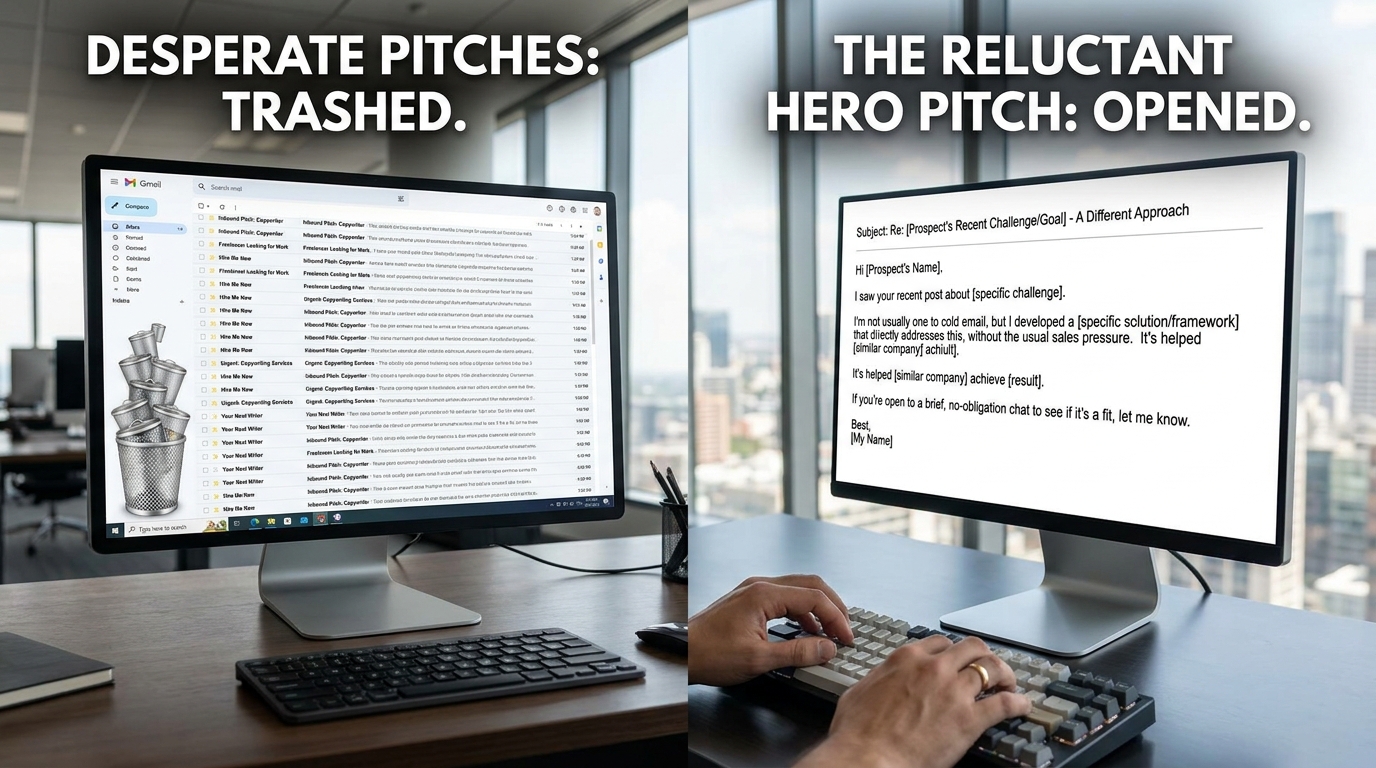
Subject: The broken link on your pricing page
Body: Your pricing page is throwing a 404 error on the enterprise tier button. I noticed it while auditing a few sites in your industry this morning.
I built a custom script that catches these dead links before you lose traffic. I ran it on your domain and found three other broken checkout flows.
Want me to send over the PDF report? No strings attached.
[Send Me The Report]
Notice the absence of “Hi, my name is.” You entered late (the problem) and left early (the offer).
Tactic 2: Subtext and Selling Without Saying It
Bad dialogue relies on characters stating their exact feelings. “I am so angry with you right now!” It feels cheap. Good dialogue relies on subtext. A character is furious, so they aggressively scrub a frying pan while refusing to make eye contact. The audience understands the anger without hearing the word.
In B2B copywriting, directly telling people “we have the best software in the industry” is cheap dialogue. Everyone says it, so nobody believes it. You need subtext. Show them you are the authority without saying the words.
When I rewrote a feature page for a supply chain software client, we stripped out the phrase “fastest inventory syncing available.” It meant nothing. We replaced it with: “If a customer buys your last shirt in New York at 2:00 PM, your Los Angeles warehouse knows by 2:00:01 PM.”
The conversion rate bumped from 1.5% to 2.8% over the next three weeks. We proved the speed without ever using the word “fast.”
The Data Subtext Protocol
Companies like Stripe excel at subtext. They rarely scream about reliability. Their API documentation acts as the subtext. They show you exactly how clean the code is. You trust them because of the demonstration, not the claim.
Replace your adjectives with anchor metrics. Instead of “highly secure,” use “SOC-2 Type II compliant with zero breaches since our 2018 launch.” Let the facts do the heavy lifting.
Tactic 3: Rhythm and The Walk-and-Talk

Screenplays have a distinct auditory rhythm. Aaron Sorkin is famous for the “walk-and-talk” scene, where characters rapid-fire dialogue while moving down a hallway. It creates a feeling of momentum. You can replicate this on a sales page by manipulating your sentence length.
Short sentences create tension. They force the reader to speed up.
Longer sentences allow the reader to relax and absorb a complex technical feature, giving their brain a moment to process the mechanics of your software before you snap them back to attention with another short, punchy line.
This mix of short and long sentences is called burstiness. It is the primary difference between human writing and machine-generated text.
Manipulating Copy Cadence
| Cadence Type | Syntax Structure | Reader Experience | Best Use Case |
| The Jab | 2 to 4 words. Punchy. Direct. | High tension. Fast scanning. | Headlines, subheads, and breaking up long paragraphs. |
| The Hook | 8 to 12 words. Conversational. | Engaging. Feels like natural speech. | Opening lines, introducing new concepts. |
| The Explainer | 20+ words with clauses and commas. | Slow, analytical. Requires focus. | Explaining complex technical features or logical arguments. |
Mix these constantly. Write a long, flowing sentence that details the specific pain point your user experiences every single day at work. Then stop. Hit them with a jab.
Tactic 4: The “Fleabag” Pivot
In the television show Fleabag, the main character constantly breaks the fourth wall. She turns to the camera and gives the audience a knowing look, acknowledging the absurdity of a situation. It builds instant, unbreakable trust between the character and the viewer.
You can break the fourth wall in your copy. Acknowledge the elephant in the room. If your product is expensive, point right at the price.
The Self-Aware Pitch
Do not hide behind a “Request Quote” button if your starting price is $5,000 a month. Acknowledge the friction.
I ran an A/B test for a cybersecurity firm targeting mid-market banks. Variant A used standard corporate speak about “optimizing security postures.” Variant B broke the fourth wall. It read: “Yes, migrating your entire security stack is a nightmare. It will take three weeks of headaches. But here is exactly why that temporary pain saves you $400,000 in compliance fines by Q3.”
Variant B drove a 34% increase in sales qualified leads (SQLs). We stopped pretending the process was easy. The audience respected the honesty.
Tactic 5: Formatting the Script for the Skimmer
Screenplays have strict formatting rules. Character names are centered. Action lines are separated. Dialogue is indented. This happens because actors and directors need to scan the page quickly to find their cues.
Your buyers are skimming, too. If they hit a landing page and see a dense, 400-word block of gray text, they bounce. You have to format the copy for the eye before they ever read it with their internal voice.
- Cap paragraphs at three sentences: Anything longer looks like a textbook on a mobile screen.
- Bold the punchlines: Treat your bold text like a character entrance. If a user only reads your H2s and your bolded words, they should still understand the entire pitch.
- Use white space as a dramatic pause: In a script, white space indicates a pause in the action. On a webpage, white space gives the reader a second to digest your previous claim.
The Table Read Protocol
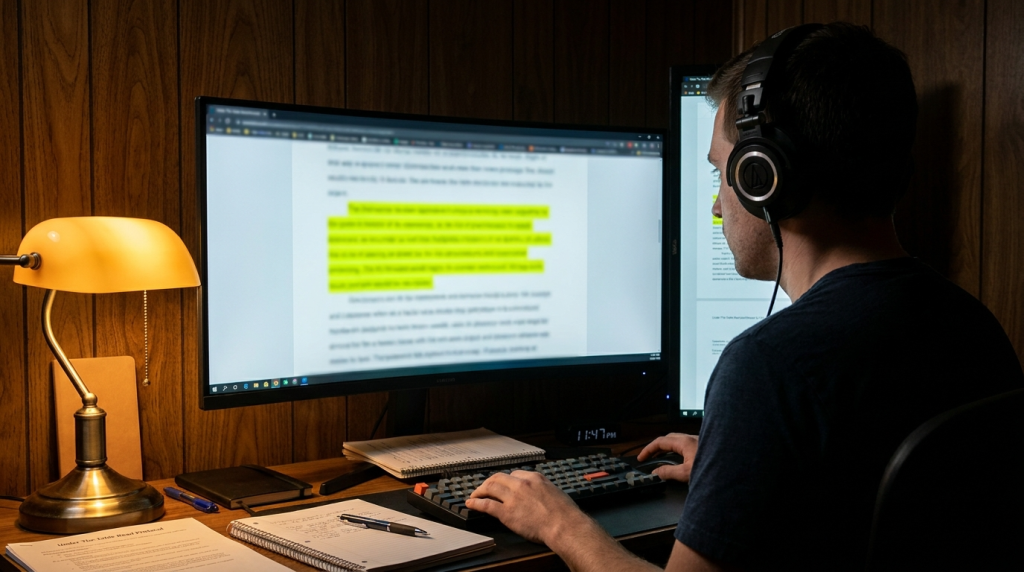
No film goes into production without a table read. The actors sit in a room and read the script out loud. They find the clunky phrases, the unnatural transitions, and the jokes that fall flat. You need a table read for your copy.
Do not just read it out loud yourself. Your brain knows what you meant to write, so it skips over the errors.
Use the text-to-speech function on your computer. Let the robotic voice read your landing page back to you. When the robot runs out of breath, your sentence is too long. When the robot sounds completely monotone and boring, you lack rhythm.
The Three-Pass Edit
- The Logic Pass: Does this argument make sense? Did I prove my claims with actual data, or am I just using adjectives?
- The Rhythm Pass: Highlight all your short sentences in yellow and long sentences in green. If you see a giant block of green, rewrite it. Force the variation.
- The Dialogue Test: Imagine sitting across from a prospect at a coffee shop. If you spoke the words on your page out loud, would they lean in, or would they look around for an excuse to leave?
Writing conversational copy is not about transcription. It is about curation. You are engineering a specific emotional reaction using rhythm, subtext, and pacing.
What is the worst piece of “corporate speak” you have had to rewrite recently?