

Stop sending the “Hi, here’s our company history” email immediately after someone downloads your lead magnet. It kills your open rates.
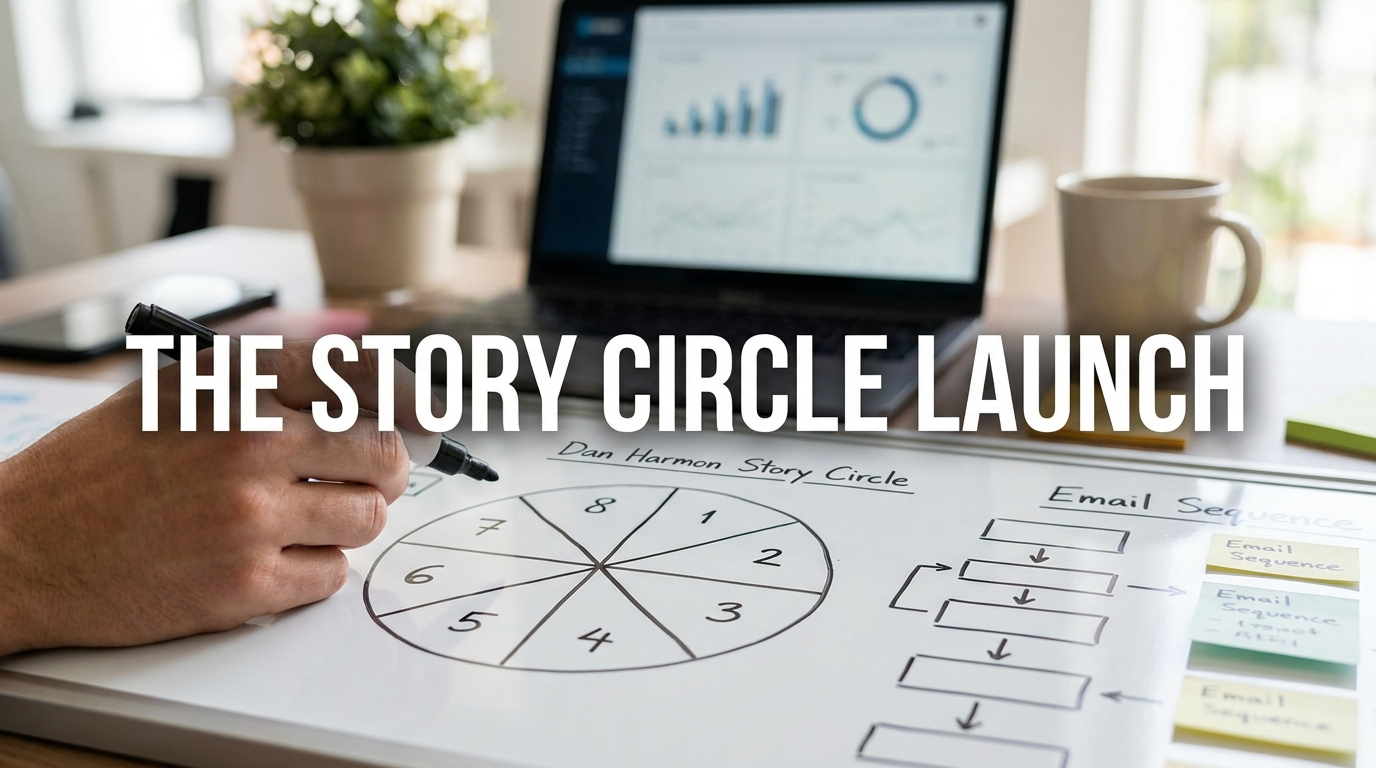
When a new subscriber hands over their email address for a PDF or a template, they do not care about your brand yet. They care about their own problems. By mapping your five-day welcome sequence to Joseph Campbell’s Hero’s Journey, you force a psychological shift. You stop being the main character. You become the Mentor. Your new subscriber becomes the Hero trying to conquer a specific pain point.
In my early years building automation sequences inside tools like ActiveCampaign and HubSpot for B2B SaaS startups, I used the standard corporate playbook. Day 1: Here is the download. Day 2: Meet the founders. Day 3: Look at these features. The results were always identical. Open rates started at a healthy 65% on Day 1 and cratered to below 12% by Day 3. Click-through rates hovered around an abysmal 0.8%.
The fix was not writing punchier subject lines. It was a complete structural teardown. I had to position the brand as the guide who had already survived the journey, handing the customer the map.
Here is exactly how to execute the 5-day monomyth sequence.
Day 1: The Call to Adventure (Delivering the Asset)
The first email has an open rate you will never see again. Your only job is to deliver the promised asset and validate their decision to start the journey.
Most marketers ruin this by attaching a heavy sales pitch at the bottom of the delivery email. Do not do this. You want to establish the “Ordinary World” the subscriber is currently living in, and challenge them to step out of it.
The Execution Blueprint:
- Subject Line: Here is your [Asset Name] (and what happens next)
- The Hook: Acknowledge the exact frustration that drove them to download the asset.
- The Delivery: Provide a clear, unmistakable link to the resource.
- The Shift: Tell them the asset is just the first step. The real problem is bigger than a single PDF.
- The Open Loop: Tell them what you are sending tomorrow.
Example: “You downloaded this pricing template because guessing your hourly rate is exhausting. The template is linked below. Tomorrow, I am going to show you the exact conversation I had with a client that made me double my rates overnight. Watch your inbox.”
Day 2: Meeting the Mentor (Your Origin Story)

The Hero cannot start the journey alone. They need a Mentor. Think of Obi-Wan Kenobi handing Luke the lightsaber. The Mentor has been through the fire, made the mistakes, and found a better way.
This is your brand’s origin story, but written with radical vulnerability. Nobody trusts a guide who has never bled. Share a specific, painful failure related to your niche.
The Execution Blueprint:
- Subject Line: Why I almost gave up on [Topic]
- The Hook: Start in the middle of your worst professional moment.
- The Agitation: Describe the pain of doing things the “old way.”
- The Pivot: Introduce the moment you realized the old way was broken.
- The Lesson: Share the core philosophy your brand or product is built on.
Do not pitch your product here. You are pitching your empathy. You are proving that you understand their exact situation because you lived it.
Day 3: Crossing the Threshold (The Paradigm Shift)
Now that you have established trust, you must force the subscriber to abandon their old way of thinking. They have to cross the threshold into the unknown.
This email breaks down an industry myth. You are giving them a new lens through which to view their problem. If you sell SEO software, you tell them why keyword stuffing is dead and intent mapping is the only way forward. If you sell meal prep plans, you destroy the myth of calorie counting and introduce macro-balancing.
The Execution Blueprint:
- Subject Line: The biggest lie we are told about [Industry/Topic]
- The Hook: Name the specific bad advice everyone else gives.
- The Proof: Explain why that advice mathematically or logically fails.
- The Framework: Introduce your proprietary method or unique angle.
- The Action: Give them one tiny, free exercise to prove your method works.
Day 4: The Ordeal (Addressing the Core Objection)
Every Hero faces a major test. In marketing, the Ordeal is the subscriber’s internal resistance. They know your method sounds good, but they are terrified it will take too much time, cost too much money, or simply not work for them.
A true expert discusses what goes wrong. Bring the core objection into the light. Tell them exactly why people fail when trying to solve this problem.
The Execution Blueprint:
- Subject Line: Why 90% of people fail at [Topic]
- The Hook: State the brutal truth about the difficulty of the task.
- The Trap: Outline the common pitfalls (e.g., burnout, wrong tools, lack of consistency).
- The Reassurance: Explain that failure is a systems problem, not a personal flaw.
This email builds massive credibility. You are setting realistic expectations. You are warning them of the traps ahead.
Day 5: The Reward (The Soft Pitch)
The Hero has accepted the call, met the Mentor, learned the new way, and faced the reality of the challenge. Now, they need the magic sword to defeat the dragon.
Your product or service is the magic sword.
You are not selling features. You are selling the easiest path through the ordeal. You have spent four days building relational equity. Now, you ask for the sale, framing it as the logical next step to complete the journey.
The Execution Blueprint:
- Subject Line: Your unfair advantage in [Topic]
- The Hook: Recap the journey you have taken them on over the last four days.
- The Pitch: Introduce your product as the vehicle that implements the new framework automatically.
- The Proof: Show a specific case study of another “Hero” (customer) who used the tool to win.
- The Call to Action: Give a clear, direct link to buy or book a call.
Analyzing the Strategic Shift

Most welcome sequences fail because they optimize for brand vanity, not user psychology. The difference between a standard setup and the monomyth approach is stark when placed side by side.
| Sequence Day | The Corporate Default | The Mentor Framework |
| Day 1 | “Here is your PDF. Buy our software.” | “Here is your PDF. The old way you work is broken.” |
| Day 2 | “Look at our awards, press, and team.” | “I failed at this too. Here is how I survived it.” |
| Day 3 | “Here is a list of our product features.” | “Here is the exact mental framework to change your approach.” |
| Day 4 | “Did you buy yet? Here is 10% off.” | “Here is the trap where most people fail when trying this.” |
| Day 5 | “Last chance to buy before we close.” | “Here is the tool to skip the hard part. Join us.” |
You can see the mechanical difference. The default sequence asks for money and attention before establishing any trust. The Mentor Framework builds deep relational equity, identifies the specific pain points, and only offers the product when the reader is psychologically prepared to receive it as a solution.
Where Most Marketers Fail with This Framework
Even with the right structure, execution falls apart if you let your ego take over. Over my career, I have audited hundreds of welcome sequences. The same three edge cases destroy conversion rates.
Before you write your sequence, guard against these common traps:
- You accidentally make yourself the Hero. You spend Day 2 bragging about your revenue numbers or your yacht. The Mentor is humble. Yoda does not brag about his midichlorian count. Talk about your scars, not your trophies.
- You refuse to polarize. On Day 3, when you challenge the industry norms, you water down your opinion to avoid offending anyone. If your viewpoint is safe, it is boring. You must aggressively attack the “old way” of doing things to make your “new way” appealing.
- You fake the failure. On Day 4, you invent a superficial objection like “Our product is just too fast for some people.” Subscribers see right through corporate humble-brags. Address a real, terrifying objection, like the high cost of implementation or the steep learning curve.
Commonly Asked Questions
Should I use double opt-in before starting this sequence?
No. Double opt-in introduces unnecessary friction. Deliver the asset immediately in email one. If they do not open Day 1 and Day 2, your email software can automatically clean them from your list later. Protect your deliverability through engagement, not roadblocks.
What if my product is low-ticket, like a $10 template?
The framework still applies, but you condense it. Instead of five days, run a three-day sequence. Combine Day 1 and Day 2. Merge Day 3 and Day 4. The psychological need for a Mentor does not disappear just because the price tag is low.
How long should the delay be between these emails?
Exactly 24 hours. When someone downloads a lead magnet, their intent is at its absolute peak. Do not wait three days to send the second email. Strike while the problem is actively bothering them.
What happens on Day 6?
They drop into your standard newsletter broadcast list. You have finished the onboarding journey. They know who you are, what you stand for, and what you sell. Treat them as a regular subscriber from this point forward.
Audit your current welcome sequence today. Look at your Day 2 email. If it starts with “We were founded in…”, delete it immediately. Replace it with a story about a failure. Document the worst mistake you made in your industry. Write down exactly how you fixed it. Send that tomorrow.