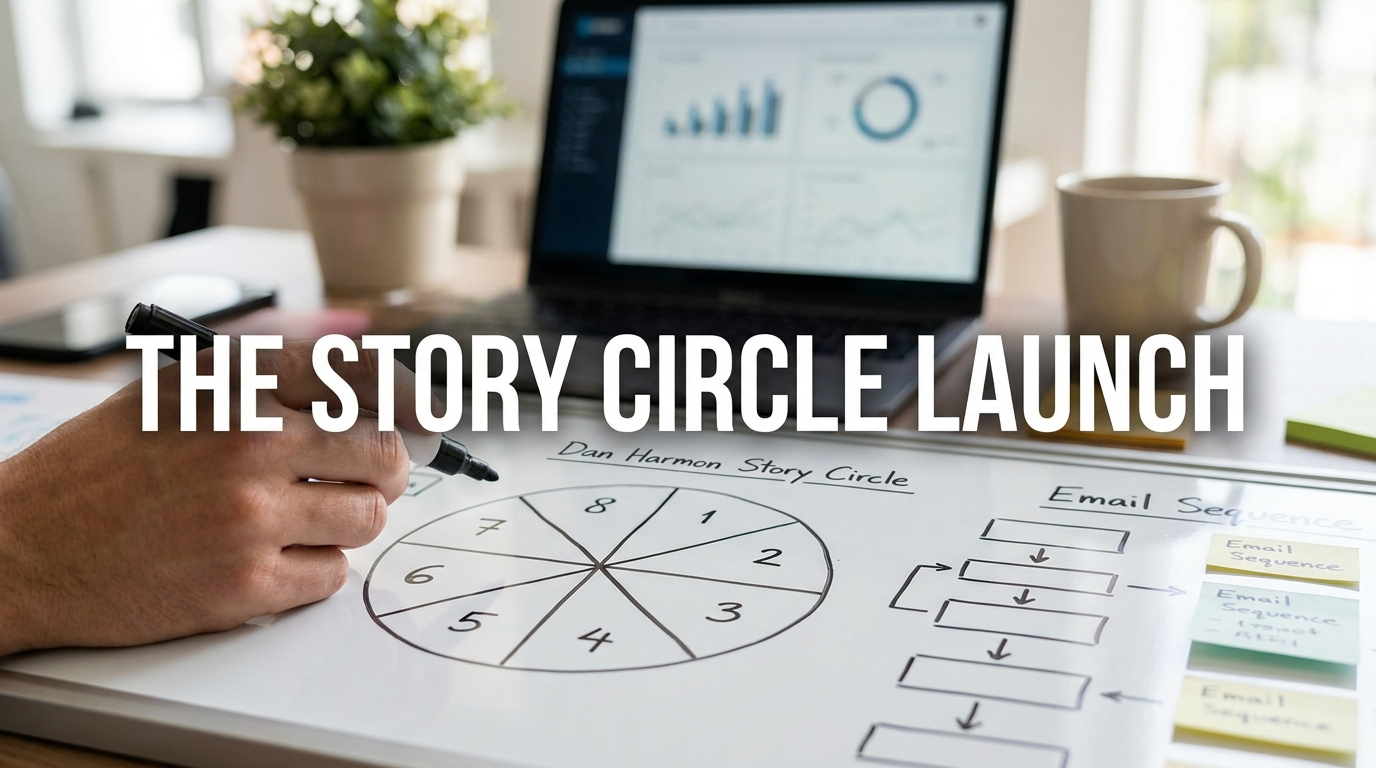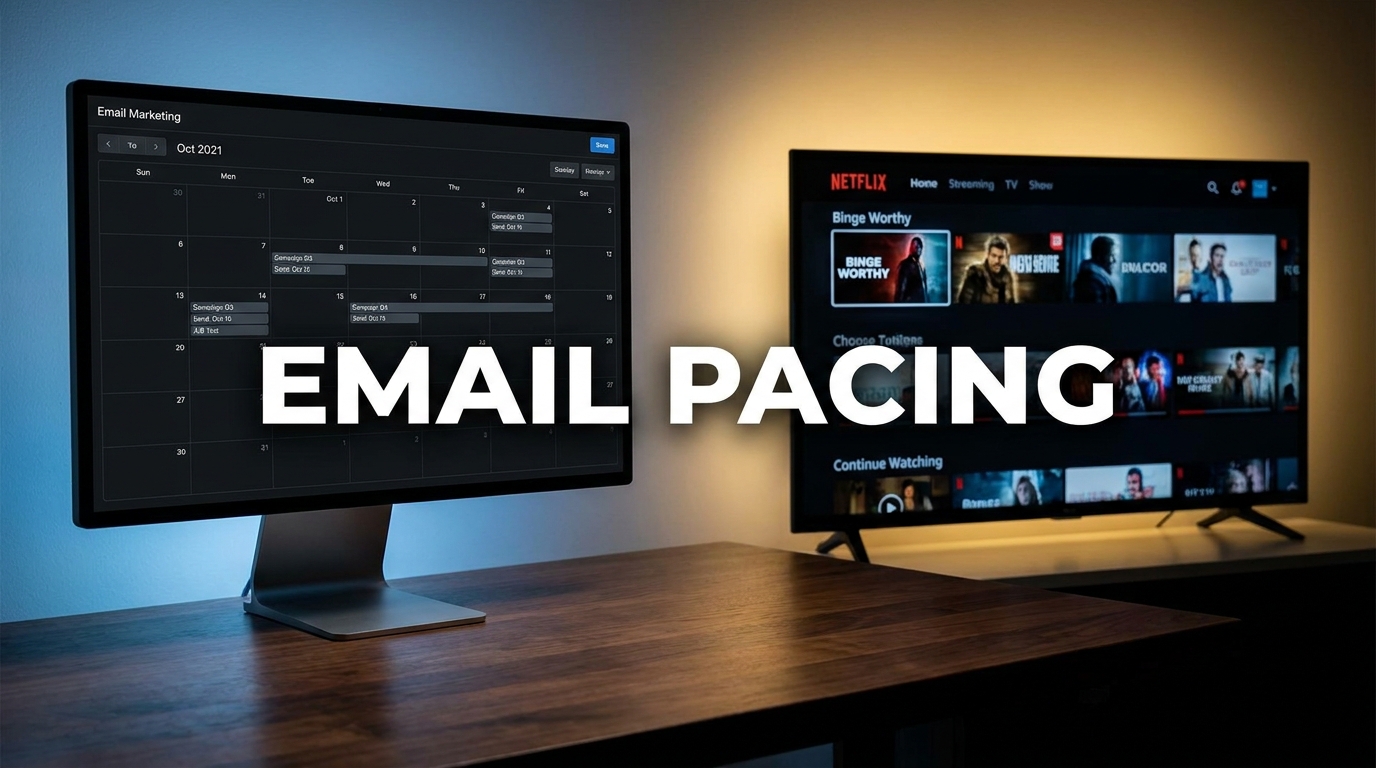

Most B2B nurture campaigns bore readers to death because they only tell the “A-Story”: the product features, the ROI, and the hard pitch. Open rates hover around an industry standard of 17%, and click-through rates flatline below 1.2% by the third email. To stop this decay, you have to borrow a technique from screenwriting called the “B-Story.” The B-Story is the emotional subplot. It’s the personal struggle, the behind-the-scenes failure, or the human tension that runs parallel to your software sale. When you weave a founder’s journey or a micro-case study into the cold mechanics of a SaaS pitch, you build parasocial trust. You stop being a vendor and become a protagonist.
B2B buyers don’t read emails to learn about your new dashboard integration. They read emails because they’re trying to solve a problem that makes them look bad to their boss. The A-Story sells the dashboard. The B-Story validates their anxiety. Look at companies like Gong or Basecamp. They don’t just list features. Gong writes about the anxiety of losing a deal on the last day of the quarter. Basecamp writes about the chaos of mismanaged teams. They understand that emotion drives the logic.
Building the Architecture of a B-Story Sequence
You can’t just slap a personal anecdote at the top of a sales email. The transition feels jarring. The subplot must tie directly to the core value proposition. You have to engineer the narrative so the product becomes the inevitable conclusion to the story.
Mapping the Parallel Arcs

Your A-Story is the logical progression toward a sale. Your B-Story is the emotional progression toward trust. Let’s say you sell inventory management software.
Your A-Story arc follows standard sales logic: Problem identification, cost of inaction, feature introduction, social proof, and a pitch.
Your B-Story arc must mirror this with human experience: A specific time you lost money due to bad tracking, the panic of telling your team, the realization that spreadsheets were failing, building a custom solution, and the resulting confidence. The two tracks must move at the exact same pace.
The 80/20 Weave
Don’t write equal parts story and pitch. Use the 80/20 weave. Spend 80% of the text on the emotional reality and 20% on the product tie-in. The human brain latches onto narratives, not bullet points. If you flip this ratio, the email reads like a thinly veiled advertisement, and your spam complaints will spike.
The 5-Day B-Story Nurture Asset
Stop guessing what to write. Here is the exact architecture for a 5-day email sequence designed to intertwine an emotional subplot with a hard B2B sale.
- Email 1: The Confession (100% B-Story). Tell the reader exactly what went wrong. Give a specific dollar amount or time lost. “We burned $40,000 on ads in 2022 because our tracking was broken.” End the email without pitching. Just promise to explain how you fixed it tomorrow.
- Email 2: The Pivot (70% B-Story, 30% A-Story). Explain the messy middle. How did you try to fix it manually? Why did that fail? Introduce your software as the thing you built out of desperation, not greed. You establish that you built the tool for yourself first.
- Email 3: The Micro-Case Study (50% B-Story, 50% A-Story). Shift the focus. Apply your B-Story to a customer. “Sarah at TechCorp had the exact same $40k leak.” Show how your tool stopped the bleeding. This provides third-party validation to your personal claim.
- Email 4: The Mechanics (20% B-Story, 80% A-Story). Now you drop the features. The reader trusts you. Explain the granular details of how the software works. Tie every technical feature back to the pain mentioned in Email 1.
- Email 5: The Direct Ask (10% B-Story, 90% A-Story). Keep it brief. Remind them of the initial pain point. Provide a clear call to action to book a demo or start a trial. The story is over; it’s time to ask for the business.
Analyzing the Impact: Standard vs. Narrative Nurturing
To understand the mechanical difference, you have to look at the structural changes and the resulting metrics. A standard sequence relies on brute force. A narrative sequence relies on momentum. The following matrix breaks down exactly what happens when you shift from an A-Story only approach to an intertwined A+B Story methodology.
| Campaign Architecture | Execution Strategy | Baseline Metric Expectation |
| The “Feature Dump” (A-Story Only) | 5 emails listing integrations, ROI calculators, and tool features. Direct CTA in every email. | 18% initial open rate. Drops to 9% by email 4. CTR below 1%. High unsubscribe rate. |
| The “Guru” (B-Story Only) | 5 emails of long, winding personal stories with no clear tie to a product solution. | 25% open rate, but near-zero conversion. Readers consume content but do not buy. |
| The “Cinematic Weave” (A+B Story) | Interlocking founder failures with specific product features. Emotional hook leads to logical pitch. | 28% sustained open rate. CTR stabilizes around 3.5%. Unsubscribes drop by half. |
The data clarifies the reality. If you only pitch, you annoy people. If you only tell stories, you entertain people without getting paid. The financial return lives entirely in the overlap.
Where Most B2B Marketers Fail
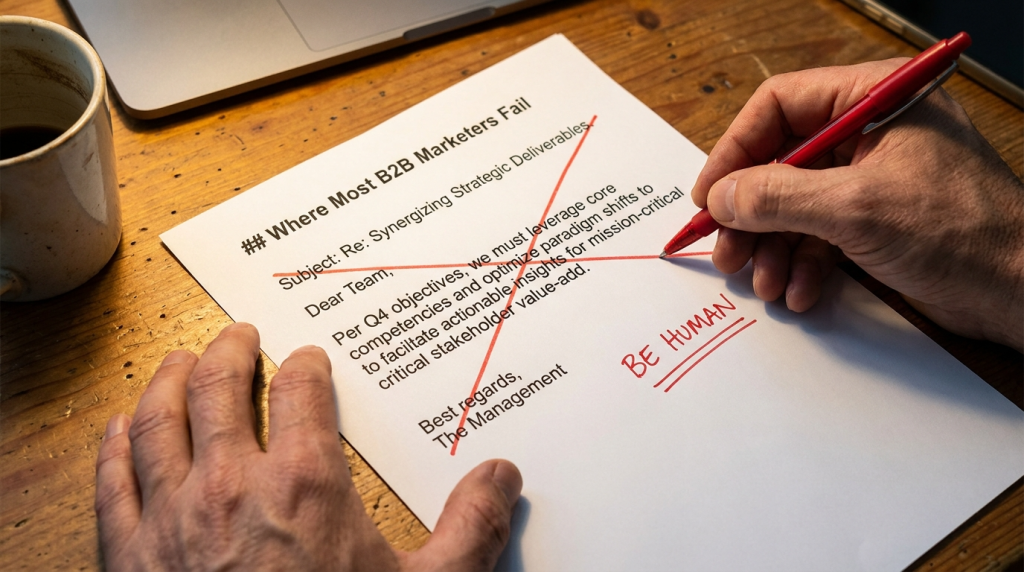
Most marketers ruin this concept within the first week. Here are the exact execution errors that destroy campaign momentum and how to fix them.
The Fake Vulnerability Trap
Don’t invent a struggle. Readers detect fabricated stories immediately. If you say you were down to your last dollar and then randomly built a multi-million dollar enterprise SaaS, it feels like a cheap infomercial. Stick to practical, mundane failures. Losing a key account because of a typo is a better B-Story than surviving a natural disaster. Authenticity requires specificity.
The Jarring Pivot
This happens when the paragraph break ruins the illusion. “I was so stressed I couldn’t sleep. Anyway, buy our CRM.” You must build a logical bridge. The emotion must naturally require the software to resolve. Transition by explaining that the stress forced you to rethink your entire workflow, which eventually became the CRM.
Cannibalizing the Call to Action
If your open rates stay high but your click-through rates drop below 0.8%, your B-Story is cannibalizing your A-Story. You’re prioritizing the narrative over the value proposition. The story exists to sell the product, not the other way around. Fix this by ruthlessly cutting down the personal anecdote in the final two emails of the sequence.
FAQs on B-Story Nurturing
How long should a B-Story email be?
Keep it under 400 words. You’re writing an email, not a novel. Get straight to the conflict in the first sentence.
What if I am a freelance copywriter and not the founder?
Interview the founder. Ask them what almost bankrupted the company in the early days. Extract their exact words and ghostwrite the sequence from their perspective.
Does this work for highly technical SaaS products?
Yes. A developer evaluating API infrastructure still experiences frustration, pressure from management, and fear of failure. Frame the B-Story around the nightmare of an undocumented codebase.
How do I test if my B-Story is working?
Watch your unsubscribe rate on email three. If they make it through the pivot from personal story to case study without unsubscribing, the hook is set.
Don’t leave your audience hanging with theory. Build your B-Story today. Here is the exact checklist to draft your first email right now:
- Identify the worst professional day the founder had related to the core problem.
- Write down the specific cost (time, money, or reputation) of that day.
- Draft a 50-word opening hook starting directly in the middle of that bad day.
- Map the resolution of that bad day to your primary software feature.