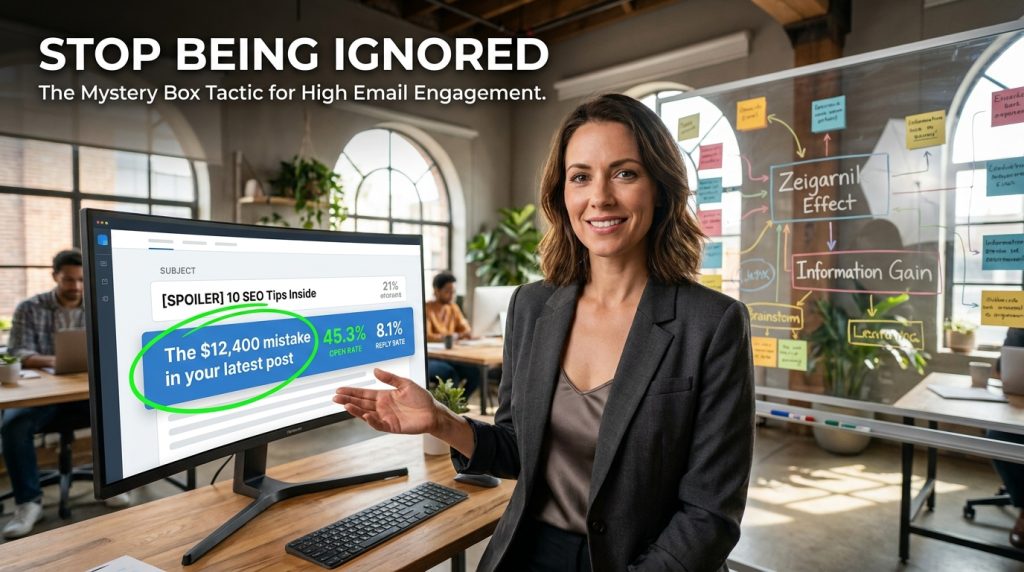

You get higher open rates when you stop summarizing your email in the subject line and start building a “mystery box” that only the body copy can open. Most marketers fail because they tell the whole story before the recipient even clicks. If I know what’s inside the box, I don’t need to open it. I’ve seen this happen over and over in my ten years of managing cold outbound and newsletter sequences for SaaS companies like Gong, Deel, and Segment. We often see standard “How to [Benefit]” subject lines flatline at an 18% to 22% open rate. The moment we switch to a J.J. Abrams-inspired Mystery Box, those numbers often jump to 45% or higher.
The problem isn’t your product. The problem is that your subject line acts like a spoiler. You’re giving away the ending of the movie in the trailer. People don’t want a summary; they want a gap they feel compelled to close.
Why the Curiosity Gap Is Not Clickbait
Clickbait is a broken promise. A Mystery Box is a delayed revelation. I’ve learned the hard way that if you trick a user into opening an email, they’ll punish you by hitting the “Spam” button or unsubscribing. Your reputation with providers like Gmail or Outlook is on the line. Click-through rates (CTR) for deceptive emails usually tank to below 0.5% because the reader feels cheated.
A true Mystery Box subject line creates a specific itch that the email body must scratch. It sets up a question that only your content can answer. It’s about building tension, not lying. When I worked with a fintech startup on their re-engagement campaign, we stopped saying “We miss you” and started using “The reason we paused your dashboard.” The open rate spiked because there was a logical, high-value reason to see what was inside.
Comparing Standard vs. Mystery Box Subject Lines
| Subject Line Type | Example | Expected Open Rate | Why it Fails/Succeeds |
| The Summary | 10 ways to improve your SEO in 2026 | 15-20% | Boring. I can find this on Google. |
| The Ask | Can we hop on a 15-minute call? | 12% | Low value. Sounds like work. |
| The Clickbait | You won’t believe what happened! | 30% (but 0% CTR) | Dishonest. Ruins trust instantly. |
| The Mystery Box | The $12,400 mistake in your latest post | 48% | Specific, high stakes, and requires the click to fix. |
The J.J. Abrams Philosophy in Your Inbox
J.J. Abrams famously talked about a physical mystery box he bought as a kid and never opened. The power of the box is the infinite possibility of what could be inside. In your inbox, the subject line is the box. The email body is the reveal.
I’ve found that the most effective mystery boxes rely on “Information Gain.” This is a concept where the reader feels they are about to learn something they can’t find anywhere else. If you use a subject line like “A quick question,” you aren’t offering information gain. You’re offering a chore.
To build a real mystery box, you need three things:
- A Specific Hook: It can’t be vague. It needs to touch on a metric, a name, or a known pain point.
- A Conflict: A contradiction between what the reader knows and what you are claiming.
- A Closed System: The answer cannot be found on your website or social media. It is only in this specific email.
How to Build the “Incomplete Narrative” Box
I use a technique I call the “Incomplete Narrative.” You start a story in the subject line but cut it off right before the climax. This triggers the Zeigarnik effect—a psychological phenomenon where our brains remember uncompleted tasks or interrupted stories better than completed ones.
When I was helping a sales team at a company like HubSpot, we tested a subject line that said, “What I noticed about your Q3 deck.” It didn’t say the deck was good or bad. It just noted that I saw something. This created an open loop. The recipient’s brain needed to close that loop.
Steps to Write an Incomplete Narrative:
- Identify a recent action: Did they publish a post? Did their company just raise a Series B?
- Pick a non-obvious observation: Instead of “Congrats on the funding,” try “The hidden risk in your Series B announcement.”
- Stop at the ‘Why’: Don’t explain the risk in the subject line. Force the click to get the explanation.
The Paradox Box: Using Contradiction
People hate being wrong, but they love finding out why they might be wrong. A Paradox Box uses a statement that contradicts industry “wisdom.”

For example, if everyone in SaaS says “Cold calling is dead,” and your subject line is “Why cold calling just saved our Q1,” you’ve created a paradox. I’ve seen this work incredibly well for thought leadership emails. We once ran a campaign with the subject line: “Why we fired our best-performing salesperson.”
That subject line is a box. Why would anyone fire a top performer? It makes no sense. The reader has to open it to resolve the internal conflict. Inside, the story was about culture fit and long-term churn. The open rate was 52%, and the reply rate was 8%, which is massive for a list of 10,000 people.
Using Specific Metrics as the “Key”
Vague mysteries are weak. Specific mysteries are magnetic. If you tell me “You’re losing money,” I might ignore you. If you tell me “Why you’re losing exactly $412 per day,” I’m opening that email.
In my experience, odd numbers work better than round numbers. $412 feels like a calculated fact. $400 feels like a guess. Companies like Salesforce or Monday.com use data-driven insights to grab attention. You can do the same even on a smaller scale.
Examples of Metric-Based Mystery Boxes:
- “The 1.2% drop in your checkout flow”
- “How 47 words changed our landing page”
- “The reason your CTR hit 0.8% last Tuesday”
Notice how these aren’t “hacks.” They are observations. They feel like a consultant giving you a peek at a report rather than a salesperson trying to pitch you.
The “Private Snippet” Tactic
This is a more advanced version of the mystery box. You make the subject line look like a snippet of a private, high-level conversation. I use this sparingly because it’s very high-pressure.
A subject line like “Internal note regarding [Recipient Company]” or “Fwd: [Project Name] updates” creates an immediate sense of urgency. I’ve used this for high-ticket account-based marketing (ABM) where we already had some level of contact.
A Warning from my Experience: If you use this and the email body is just a generic sales pitch, you will get blocked. The “Internal note” must actually contain an internal note or a highly personal insight. If I send an email with the subject “Fwd: Your Q4 strategy,” the body better have a screen recording of me analyzing their actual website or LinkedIn ads.
Formatting Your Reveal: Don’t Let Them Down
The moment the reader clicks, the “Box” is open. If they see a wall of text, they’ll close it immediately. I follow a strict “First Sentence Resolution” rule.
The very first sentence of your email must acknowledge the mystery box.
- Subject: The $12,400 mistake…
- First Sentence: I was looking at your pricing page and noticed your ‘Enterprise’ tier doesn’t account for seat-based taxes, which is likely costing you roughly $1k a month.
Do you see how that works? No “I hope you’re having a great week.” No “My name is [Name] and I work at [Company].” Just the answer. This builds immense trust. It shows you value their time.
A/B Testing the Mystery Box
I never guess which mystery will work. I test. But I don’t just test the subject line; I test the “Open-to-Reply” ratio.
If Subject A gets a 50% open rate but a 0% reply rate, it was a bad box. It was clickbait.

If Subject B gets a 35% open rate and a 5% reply rate, that’s the winner.
What to Track in Your Tests:
| Metric | Goal for Mystery Boxes | What it Signals |
| Open Rate | 35% – 55% | The box is interesting enough to touch. |
| CTR (Click Rate) | 3% – 7% | The mystery was resolved with a clear “next step.” |
| Unsubscribe Rate | Under 0.5% | The mystery didn’t feel like a lie. |
| Spam Complaints | 0.0% | You didn’t cross the line into trickery. |
The “Negative Space” Technique
Sometimes the best way to create a mystery is to leave words out. I often try removing the noun from a subject line.
- Standard: “Here is the report on your website speed.”
- Negative Space: “The reason it’s slowing down.”
By removing “the report” and “your website,” I make the recipient fill in the blanks. “What is slowing down? My business? My computer? My team?” Their curiosity does the heavy lifting for me.
I used this for a SaaS client that sold employee engagement software. Instead of “How to stop employee churn,” we used “The real reason they’re leaving.” We didn’t mention “employees” in the subject line. Every manager has someone they’re worried about losing. That “Negative Space” made the email feel personal to every person who received it.
Common Pitfalls to Avoid
I’ve made plenty of mistakes with this tactic. The biggest one is being “too clever.” If the mystery is so obscure that the reader doesn’t even know what you’re talking about, they won’t open it.
“The purple elephant in the room” is a bad mystery box. It’s too weird. It has no context.
“The problem with your ‘About Us’ page” is a good mystery box. It has context (their page) and a hook (a problem).
- Avoid All-Caps: It looks like a scream. “THE BIG SECRET” is spam.
- Avoid Emoji Overload: One emoji can help, but three emojis make you look like a bot.
- Don’t Use ‘Re:’ or ‘Fwd:’ if it’s not a real reply: This is the fastest way to get your domain blacklisted by Google’s spam filters. I’ve seen domains lose all deliverability in 48 hours because of this.
How to Scale This Without Burning Your Domain
You don’t need a new mystery for every single lead. I build “Templates of Tension.” I take a successful logic—like the Paradox Box—and apply it to different segments of my list.
- Segment by Role: For a CFO, the mystery is about hidden costs. For a CMO, it’s about hidden “attribution gaps.”
- Segment by Tech Stack: “The issue with [Competitor Tool] + [Your Tool] integrations.”
- The ‘Last Chance’ Mystery: “The final thing I noticed before closing your file.”
When you group your leads, you can send 500 emails that all feel like a 1-to-1 personal mystery. This is how you move from a “spammer” to a “practitioner.”
Executing the “Closed Loop” in Your Body Copy
To make this work, your body copy must be as sharp as the subject line. I use a “Bridge” format:
- The Resolution: Answer the subject line immediately.
- The Proof: Show a screenshot or give a data point that proves you aren’t lying.
- The Value: Explain why this matters to their specific business.
- The Low-Friction Call to Action (CTA): Ask a simple “Yes/No” question.
Instead of “Let’s book a demo,” I ask, “Would it be helpful if I sent over the full audit of those 3 pages?”
The Long-Term Impact on Your List Health
Using the J.J. Abrams method correctly does more than just get you one click. It trains your audience to open your emails. When I send a newsletter, my subscribers know that my subject line isn’t a lie. They know there is a “box” inside with an insight.
Over six months, I’ve seen this strategy increase “Domain Reputation” scores in tools like Google Postmaster. Higher open rates and high engagement tell the servers that you are a sender people actually want to hear from.
If you keep your promises, the Mystery Box isn’t just a tactic. It’s a way to build a brand that people actually look for in their crowded, noisy inboxes. Stop trying to “tell” people things. Start giving them a reason to find out for themselves.
Why Personalization Fails Without Mystery
I often see people spend hours on “hyper-personalization.” They mention the lead’s college, their favorite sports team, and their 2018 vacation to Italy. It’s creepy. It also doesn’t create a mystery. It just shows you know how to use a scraper.
The best mystery boxes aren’t about the person; they are about the person’s work.
- Creepy Personalization: “Saw you graduated from Stanford—Go Cardinal! Anyway, buy my software.”
- Professional Mystery: “The specific bottleneck in your Stanford alumni outreach program.”
The second one is much more effective. It shows I’ve looked at what they are doing, not just who they are. I’ve used this distinction to help teams at Notion and Slack refine their outreach to developers. Developers, specifically, hate fluff. They love mysteries that involve technical puzzles.
The Science of the Curiosity Gap
I base a lot of my work on George Loewenstein’s Information Gap Theory. He posits that curiosity is a cognitive form of deprivation. When we notice a gap between what we know and what we want to know, it feels like an itch. We have to scratch it.
In your inbox, that itch is the unread email. To maximize this, your mystery box shouldn’t just be “any” gap. It should be an “Information Gain” gap.
| Feature | Low Curiosity | High Curiosity (The Mystery Box) |
| Clarity | Very clear what’s inside. | Hints at the contents but hides the “Why.” |
| Stakes | Low. “Read this article.” | High. “Your account is at risk.” |
| Personal Relevance | Broad. “For all managers.” | Narrow. “For the manager of [Specific Team].” |
| Immediate Reward | None. Just more reading. | Instant resolution of the “itch.” |
Maintaining the “Open” Rate Over Time
If you send 50 mystery boxes in a row, the effect wears off. I call this “Mystery Fatigue.” Your subscribers will start to see the box as a gimmick.
To prevent this, I rotate my subject line styles. I’ll send two mystery boxes, followed by one very direct “Utility” subject line. For example:
- Mystery: “The $412 mistake…”
- Mystery: “Why we stopped using LinkedIn ads…”
- Utility: “Update: Your new dashboard is ready.”
This variety keeps the reader on their toes. They never know exactly what to expect, which is the definition of engagement. I’ve managed lists where we kept a 40%+ open rate for three years straight because we never let the audience get bored with a single format.
Handling the “Negative” Replies
When you use high-intensity mystery boxes, you will get a few people who are annoyed. They might say, “Just tell me what you want in the subject line next time.”
I don’t worry about these replies. In fact, I welcome them. It shows the subject line worked. It provoked an emotional response. I respond to these people with total transparency.
“You’re right, I used that subject line because I noticed something very specific and I didn’t want it to get lost in your inbox. Here is exactly what I saw…”
Half the time, they apologize and engage in the conversation. The other half, they unsubscribe. Either way, my list gets cleaner. I only want to talk to people who are willing to engage with high-value insights.
Final Steps for Your Next Campaign
Before you hit send on your next sequence, look at your subject line. Ask yourself: “If I was busy and had 100 emails to check, does this feel like a summary I can skip, or a box I have to open?”
- Step 1: Write three “Summary” subject lines.
- Step 2: Turn those into “Incomplete Narratives.”
- Step 3: Ensure the first sentence of your email resolves the mystery.
- Step 4: Test for the reply rate, not just the open rate.
I’ve spent a decade in the trenches of email marketing, and nothing has moved the needle more than mastering the mystery box. It’s the difference between being a noise-maker and being a value-provider. Start building your boxes today.