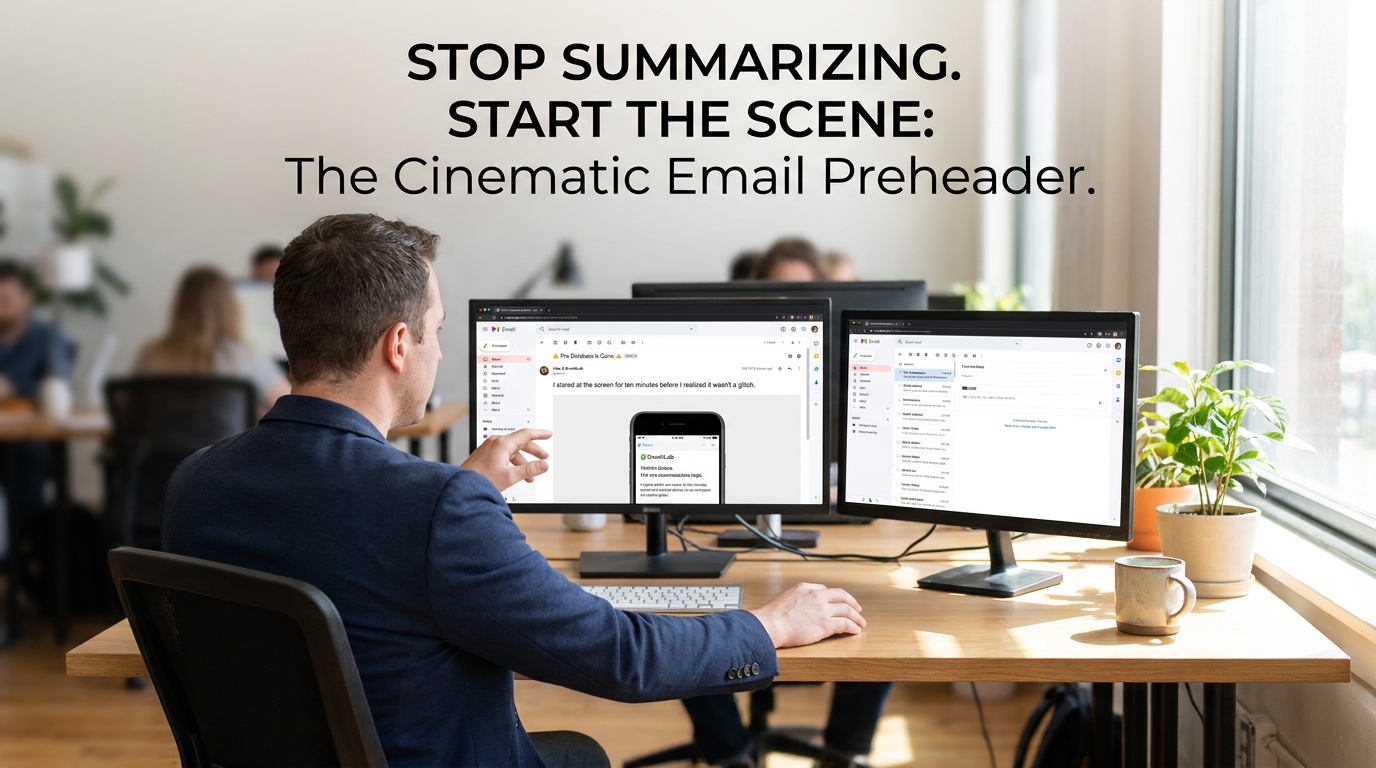

Most B2B webinar invitations read exactly like a college syllabus. You outline all three talking points, explain the exact methodology, and summarize the takeaways right there in the body copy. Then you wonder why click-through rates flatline below 1.2% and live attendance drops off a cliff. If you give away the entire plot in the email, no one buys a ticket to the movie.
You fix this by treating your webinar invitation sequence like a cinematic teaser trailer. You reveal the “What” and the “Stakes,” but you strictly hide the “How.”
The internet is saturated with free information. Buyers do not want another 45-minute educational lecture. They want solutions to specific pain points. When you explain exactly how your solution works in the invitation, you trigger a mental checklist. The reader thinks, “I already know that,” or “That sounds too hard,” and they delete the email.
The Teaser Trailer Formula relies on the curiosity gap. You show them a highly specific problem they have. You show them the negative outcome of ignoring that problem. You tell them a solution exists. You make them register to find out what that solution actually is.
The Anatomy of the Teaser Trailer Formula
Think about how major studios promote a blockbuster film. The first trailer does not explain the plot. It shows an explosion. It shows the villain looking menacing. It shows the hero backed into a corner. It leaves you with questions.
Your webinar sequence must do the exact same thing for B2B buyers. Companies like Gong or Notion excel at this. They do not sell the features of the webinar; they sell the gap in your current knowledge.
Here is the exact structure you need to apply to your messaging:
- Reveal the What: Name the exact, specific result you achieved or the specific trend you discovered. (e.g., “We found the exact email sequence that lifted reply rates to 4.5%.”)
- Reveal the Stakes: Show them what they lose by ignoring this information. (e.g., “Continuing to use standard templates is costing your SDRs 5 hours a week and bleeding your pipeline.”)
- Hide the How: Never explain the steps in the email. The “How” is the cost of admission. (e.g., “We are breaking down this exact sequence on Thursday.”)
Standard Invites vs. The Teaser Formula
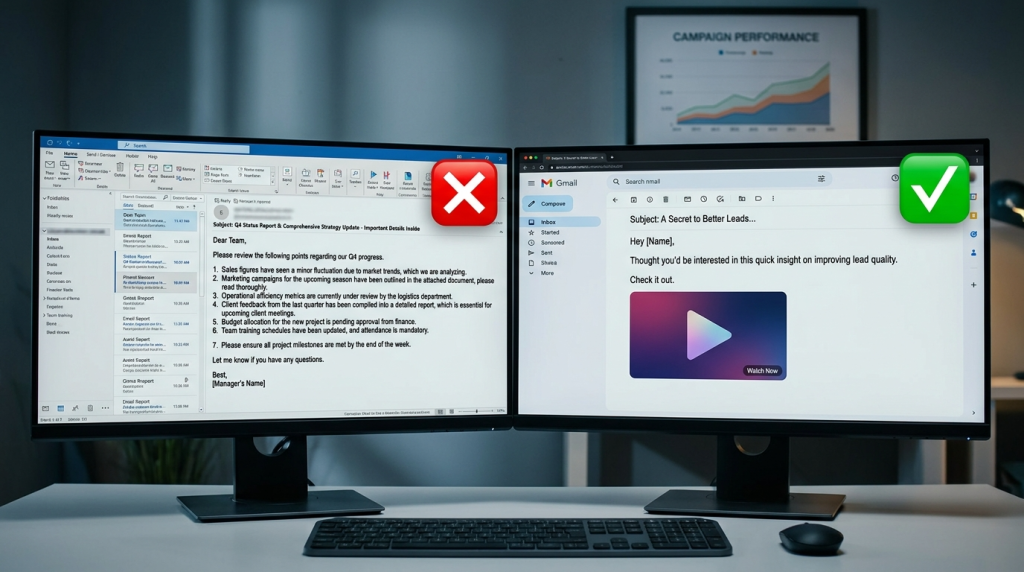
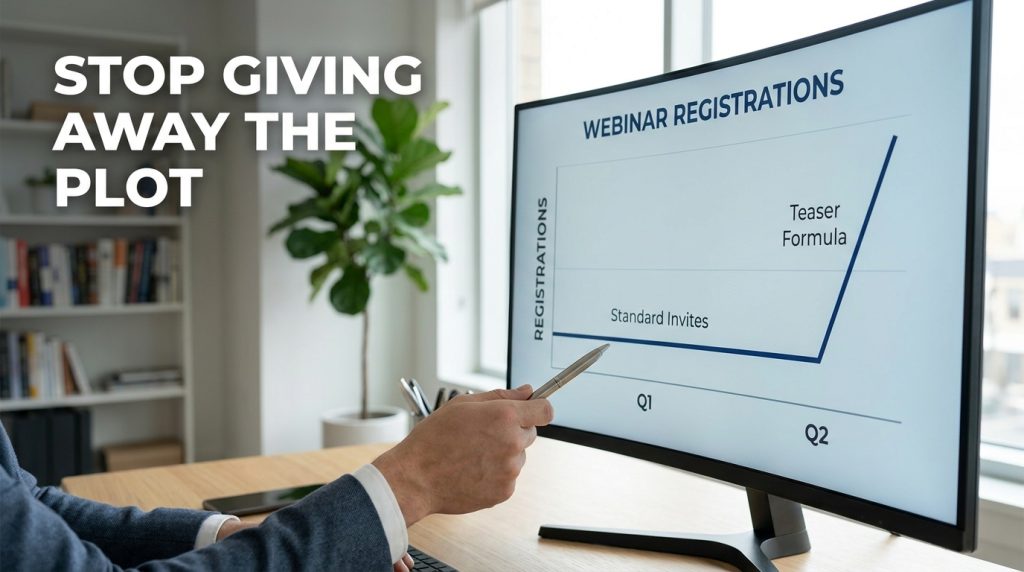
The standard baseline for B2B webinar attendance often hovers around 35-40% of total registrants. When you shift from a syllabus to a teaser, the psychology of the registrant changes. They show up because they literally cannot implement the idea without seeing the presentation.
| Copy Element | Standard “Syllabus” Invite | The Teaser Trailer Formula |
| Subject Line | Join our webinar on Q3 Sales Tactics | The Q3 sales tactic costing you 15% in pipeline |
| The Hook | In this webinar, we will cover X, Y, and Z. | Most reps lose deals at the proposal stage. We found out why. |
| The Pitch | Learn how to use our platform to send better emails. | We discovered a three-step framework that reverses this trend. |
| The CTA | Register now to learn more | See the exact framework on Thursday |
| Registrant Mindset | “I’ll just wait for the recording.” | “I need to see this framework before my competitors do.” |
The Three-Part Email Sequence Execution

Stop sending single, desperate emails the day before the event. A teaser campaign builds momentum. You need a structured timeline that slowly dials up the pressure and the curiosity.
Here is the exact framework and copy structure for a high-converting teaser sequence.
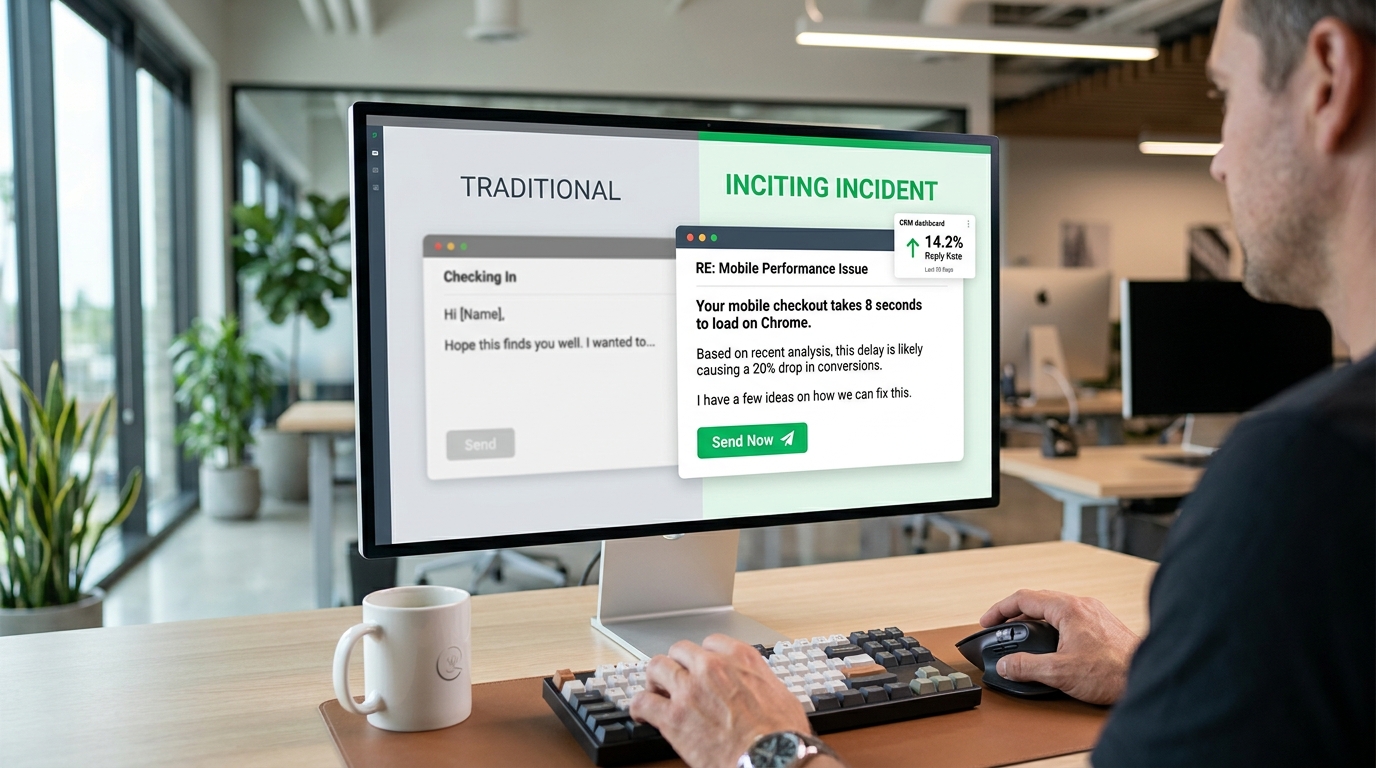
Email 1: The Inciting Incident (Sent 7 Days Out)
Your first email introduces the problem. You are not selling the webinar here. You are selling the pain point. You need to identify a specific, measurable issue your target audience faces right now.
Subject Line Idea: The [Specific Metric] drop-off no one is talking about.
Subject Line Example: The Q2 churn metric no one is talking about.
Body Copy Structure:
Start with an observation that challenges their current thinking. State a hard fact.
“Right now, most customer success teams are tracking account health scores wrong. You look at login frequency. You look at feature usage.
But our data shows accounts with high login frequency are actually 20% more likely to churn in month six. They aren’t logging in because they love the tool. They are logging in because they are stuck.
We completely rebuilt how we track account health to catch this ‘frustration usage’ before the client cancels.”
The CTA: Do not say “Register for our webinar.” Say what they get.
“We are pulling back the curtain on this new tracking model next Tuesday. Get the breakdown here.”
Email 2: The Villain and the Stakes (Sent 4 Days Out)
If they did not click the first email, the pain point wasn’t sharp enough. The second email introduces the villain. In B2B marketing, the villain is rarely a competitor. The villain is the status quo. It is an outdated process, a bloated tech stack, or a legacy mindset.
Subject Line Idea: Why your [Current Process] is breaking.
Subject Line Example: Why your automated onboarding sequence is breaking.
Body Copy Structure:
Call out the exact thing they are doing right now and explain why it is actively harming them.
“You probably set up your automated onboarding emails six months ago. Day 1: Welcome. Day 3: Try this feature. Day 7: Upgrade to pro.
It feels efficient. It is also actively killing your conversion rates. When you treat every new sign-up like they have the exact same use case, you train them to ignore your emails.
There is a better way to segment users on day one without asking them to fill out a massive form.”
The CTA:
“I’m walking through the exact segmentation workflow we use on Thursday. Reserve your spot to see the workflow.”
Email 3: The Climax and FOMO (Sent 24 Hours Prior)
This is the final push. Keep it incredibly short. The stakes are established. The problem is clear. Now you just apply the pressure of time.
Subject Line Idea: The [Name of Framework] reveal (Tomorrow).
Subject Line Example: The zero-form segmentation reveal (Tomorrow).
Body Copy Structure:
No long introductions. Just a quick reminder of the massive gap in their knowledge.
“Tomorrow at 1 PM EST, we are showing exactly how we bypass traditional onboarding forms to segment users instantly.
We will share the exact triggers we use. We will share the exact copy.
If your trial-to-paid conversion rate is stuck below 5%, you need to see this.”
The CTA:
“Grab one of the final spots here.”
Aligning the Landing Page
The biggest mistake marketers make with this formula happens right after the click. The email builds a massive curiosity gap, the user clicks the link, and the landing page instantly ruins the surprise.
If your email says, “We found a secret method,” and your landing page features a giant header that says, “Learn how to use AI to write emails,” you just answered the question. The curiosity gap closes. The user bounces.
Your registration page must maintain the exact same level of mystery as the email sequence.
Rules for the Teaser Landing Page
- Match the Headline: The landing page headline must exactly match the promise of the email. If the email promised a “three-step framework for reversing churn,” the headline must be “The Three-Step Framework for Reversing Churn.”
- Limit the Bullets: Registration pages usually feature 5 to 7 bullet points outlining the agenda. Cut that down to three. Focus on the transformation, not the specific educational steps.
- Keep the Focus on the Gap: Use copy that reinforces what they are missing. “Discover the single metric that…” or “See the internal dashboard we use to…”
The Post-Registration Hold
Getting the registration is only half the battle. The industry average show rate for webinars is abysmal because people forget why they signed up. You have a gap of several days between registration and the live event.
Do not just send a calendar invite. You need a “Hold” sequence.
A Hold sequence consists of one or two micro-emails sent between the registration confirmation and the live event. These emails serve one purpose: to prove that the “How” you are hiding is actually worth their time.
The “Proof” Micro-Email (Sent 2 Days Before Event):
Send a plain text email. Keep it under four sentences. You want to validate their decision to register.
“Hey [Name], glad you grabbed a spot for Thursday.
Just wanted to send a quick note before the presentation. When we first implemented the framework you’re going to see, it took our internal conversion rate from 2.1% to 4.8% in about three weeks.
Have a notebook ready for the second half of the call. I’m going to move fast.”
This email does not sell. It does not ask for anything. It simply builds anticipation for the actual event. You keep the mechanics hidden, you remind them of the stakes, and you force them to show up live to get the missing pieces.