
Why 2027 Is a Surprisingly Good Year to Be a Saver
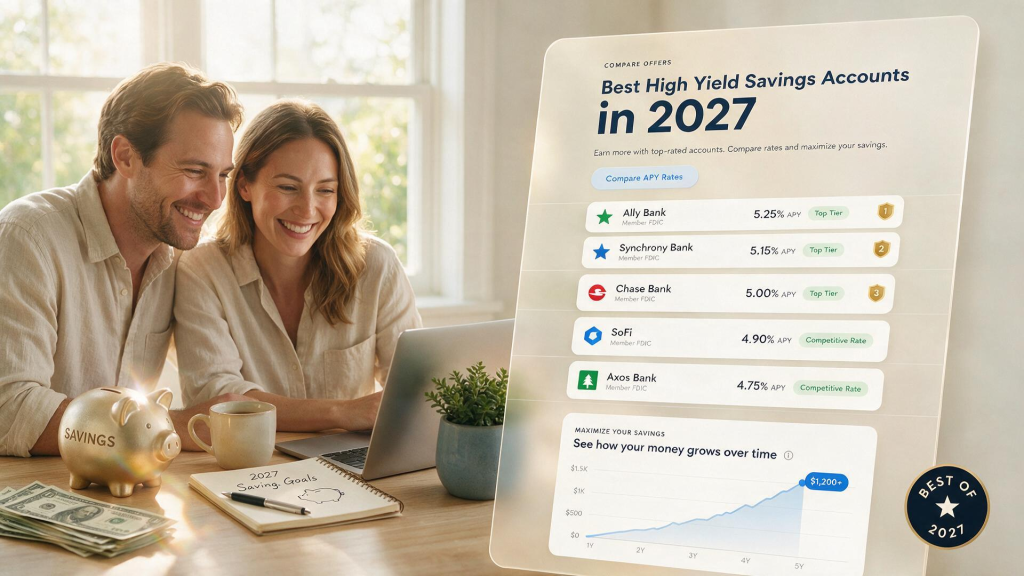
The conventional wisdom about savings accounts has always been that they are a sucker’s bet, a place where your money sits idle while inflation quietly eats away at its purchasing power. For most of the 2010s, that criticism was entirely fair. The national average savings rate hovered near zero for years, and anyone who kept meaningful cash in a traditional account was effectively paying a penalty for the privilege of liquidity. But the rate environment of 2027 tells a different story. According to data from the FDIC, the average savings account in early 2027 is still yielding somewhere around 0.46 percent, a figure that remains stubbornly low. Meanwhile, the top-tier accounts from online-first institutions are offering APYs in the range of 4.35 to 4.60 percent, and some promotional offers have pushed even higher. That spread, roughly four full percentage points, is not a minor difference. It is the difference between your emergency fund growing meaningfully each month and it slowly eroding in real terms.
The macro backdrop explains why this window has stayed open longer than many forecasters expected. Goldman Sachs Research pushed its projection for the Federal Reserve’s next rate cuts from late 2026 and early 2027 out to June and December of 2027, citing stronger-than-expected economic activity and labor market data. For savers, that delay is a gift. High-yield savings rates are variable and tied loosely to the federal funds rate, so every month that the Fed holds steady is another month where your cash can earn a competitive return. Barbara O’Neill, a certified financial planner, noted that even a 3.5 percent account earns nearly ten times more than the average traditional savings account, and she described the delayed cuts as “a good sign for savers interested in earning competitive market yields.” The opportunity is real, but it is also temporary. Rates will eventually drift lower as the Fed normalizes policy, which makes the case for acting deliberately rather than waiting for a better offer that may never arrive. Anyone searching for the best high yield savings accounts 2027 has a genuine advantage right now, provided they know where to look and what to avoid.
There is a psychological hurdle to clear first. Many people equate “savings account” with the account they opened at their parents’ bank two decades ago, the one that pays a fraction of a percent and charges a fee if the balance dips below a thousand dollars. That account still exists, and it is still a bad deal. The modern high-yield landscape is dominated by online banks and fintech platforms that have no branch overhead, no legacy cost structure, and a genuine need to attract deposits. These institutions compete aggressively on rate, and the competition has only intensified as challenger banks have grown more confident in their ability to retain customers. A February 2027 analysis from the Consumer Financial Protection Bureau found that consumers who actively shopped for savings rates earned an average of 3.8 percentage points more annually than those who simply left their cash at their primary checking institution. That is not a marginal gain. On a $20,000 emergency fund, it is roughly $760 per year that most people are leaving on the table out of sheer inertia.
How to Compare High Yield Savings Rates Without Getting Fooled
The headline APY is the first thing you see and the last thing you should trust in isolation. Banks have become remarkably creative about structuring their rates in ways that make the advertised number look better than what most depositors actually earn. The most common tactic is the tiered rate, where the advertised APY applies only to a specific balance range. A bank might advertise 4.60 percent, but bury in the disclosure that the rate applies only to the first $5,000, with balances above that earning 0.50 percent or less. If you deposit $25,000 into that account, your blended effective rate might be closer to 1.3 percent, which is barely better than a traditional account. The fix is simple: before you open anything, find the full rate schedule and calculate the blended APY on the balance you actually plan to deposit. If the bank cannot or will not provide that schedule clearly, that is your answer.
Promotional rates are the second trap. Several institutions offer boosted APYs for the first six months or for new customers only, after which the rate reverts to a standard variable rate that may be substantially lower. Openbank, for example, has advertised a promotional APY that includes a 0.35 percent boost for six months, after which the account earns the standard variable rate. These promotions are not inherently bad, and if you are disciplined about moving your money when the promotional period ends, you can capture the higher rate and then switch to a better long-term option. But the vast majority of depositors do not move their money. They open the account, set up direct deposit, and forget about it, which is precisely what the promotional structure is designed to encourage. If you choose a promotional account, put a calendar reminder on your phone for the week before the boost expires. Treat the expiration date as a deadline for action, not a suggestion.
The third variable is the minimum balance or activity requirement. Some of the most competitive high yield savings rates come with strings attached. LendingClub’s LevelUp Savings account, for instance, requires a monthly deposit of at least $250 to earn its top rate; without that deposit, the account earns a standard rate that is considerably less impressive. CIT Bank has historically required a minimum balance of $5,000 to qualify for its highest tier, with lower balances earning a fraction of the headline rate. These requirements are not deal-breakers, but they change the calculus. If you cannot meet the monthly deposit or maintain the minimum balance, the account is not actually offering you the rate you think it is. Read the terms as if the bank is looking for a reason to pay you less, because in a sense it is. The best savings account interest rates are only meaningful if you can actually qualify for them without changing your financial habits in ways that defeat the purpose.
Fees deserve a mention here as well, though they have become less of a concern in the online savings space. Most of the top-tier accounts charge no monthly maintenance fee and have no minimum opening deposit. But a few still do, and the fees can quietly erode the advantage of a higher rate. A $5 monthly fee on a $10,000 balance earning 4.00 percent reduces your effective return by roughly 0.6 percentage points, which is a meaningful chunk of the yield you thought you were getting. The good news is that fee-free accounts are abundant, and there is no reason to accept a fee on a savings product in 2027. If an account charges a monthly fee, move on. The market is too competitive to settle.
The Case for Online Savings Accounts Over Traditional Banks
The brick-and-mortar bank where you keep your checking account is almost certainly not the place where your savings should live. This is not a criticism of traditional banks as institutions; it is a structural reality of how they operate. Branches, tellers, and legacy technology systems cost money, and that money comes out of the rates the bank can afford to pay depositors. Online banks have none of that overhead, and they pass the savings through in the form of higher yields. The gap is not small. A traditional bank might offer 0.30 percent on a savings account while an online competitor offers 4.30 percent for the same FDIC insurance protection. The only meaningful difference between the two accounts, from a safety perspective, is zero.
That safety point is worth dwelling on because it is the most common objection to online banking. “What if the bank fails?” is a reasonable question, and the answer is straightforward. FDIC insurance covers deposits at insured banks dollar-for-dollar, up to at least $250,000 per depositor, per institution, for each ownership category. This coverage applies to savings accounts, checking accounts, and certificates of deposit, and it does not matter whether the bank has a physical branch in your town or operates entirely through an app. The FDIC has been insuring deposits since 1934, and no depositor has ever lost a penny in an insured account at a failed bank. The coverage is backed by the full faith and credit of the United States government, which means the safety of your money depends on the solvency of the federal government, not the solvency of the bank. If that distinction feels abstract, consider that the same guarantee applies to the traditional bank down the street. The FDIC insured banks that operate online are subject to the same regulatory oversight and the same insurance framework as the ones with marble lobbies and drive-through windows.
There is one practical wrinkle worth noting. If you are depositing more than $250,000, you need to think about how to structure your accounts to stay within the insurance limit. The FDIC insures deposits per depositor, per institution, per ownership category, which means a single person with $500,000 at one bank has $250,000 of coverage, not $500,000. But that same person could open accounts at two different FDIC-insured banks and have $500,000 fully covered. Alternatively, they could hold the funds in different ownership categories, such as a single account and a joint account, or use a trust structure to increase coverage. The rules are not complicated, but they do require a bit of planning. For the vast majority of savers with emergency funds and short-term savings goals, the $250,000 limit is far more than enough, and the question is academic. But if you are parking a significant sum from a home sale or an inheritance, spend an hour with the FDIC’s online tool or a knowledgeable banker to make sure every dollar is covered.
The operational differences between online and traditional banks are smaller than they used to be. Most online banks offer mobile check deposit, ACH transfers, and debit cards, and many have improved their customer service to the point where phone and chat support are genuinely responsive. The main friction point is cash deposits. If you regularly deposit cash, an online-only bank is inconvenient because you cannot hand your money to a teller. The workaround is to keep a small account at a traditional bank for cash transactions and transfer the funds electronically to your high-yield account. It is an extra step, but it is a small price to pay for a four-percentage-point yield advantage. The savers who figure this out early are the ones who capture the full benefit of the rate environment. The ones who let the inconvenience stop them are the ones who keep earning 0.46 percent while their neighbors earn 4.5.
Using an APY Calculator to See What Your Savings Could Actually Earn
The abstract appeal of a higher interest rate is easy to grasp, but the concrete numbers are what motivate behavior change. This is where an APY calculator becomes genuinely useful. The tool itself is simple: you input your deposit amount, the APY, and the time period, and it tells you what your balance will be at the end. But the output often surprises people. A $10,000 deposit at 4.10 percent for nine months earns roughly $306 in interest. The same deposit at 0.46 percent earns about $34. The difference, $272, is not life-changing money, but it is a dinner out, a tank of gas, or a small contribution to a retirement account. And that is on a relatively modest balance over a short period. Scale it up to a $30,000 emergency fund held for two years, and the difference between a high-yield account and a traditional one exceeds $2,000.
The calculator is also useful for comparing account structures. If one bank offers 4.50 percent with no minimum and another offers 4.75 percent but requires a $10,000 minimum balance, the calculator can tell you whether the extra 0.25 percent is worth the constraint on your liquidity. If you have $12,000 to deposit, the higher rate applies to the full balance, and the difference is meaningful. If you have $8,000, the higher-rate account is unavailable to you, and the comparison is moot. Running the numbers takes about thirty seconds, and it prevents the kind of mistake where you chase a headline rate that does not actually apply to your situation. The calculator also helps with goal-setting. If you want to save $5,000 for a home repair in eighteen months, you can work backward to determine how much you need to deposit each month at a given rate to hit the target. That is a more useful exercise than simply picking an account and hoping for the best.
One caveat about calculators: they assume a constant APY, which is not how variable-rate savings accounts actually work. The APY on a high-yield savings account can change at any time, and it almost certainly will change over the course of a year or two. When the Fed cuts rates, online banks tend to follow within weeks. When the Fed raises rates, the increases tend to flow through more slowly. This asymmetry is worth understanding. The calculator gives you a snapshot based on today’s rate, not a guarantee of future returns. For a more conservative estimate, run the calculation at a rate half a percentage point lower than the current offer and see if the result still feels worthwhile. If it does, the account is probably a good fit. If the entire value proposition collapses when you stress-test the rate, you are probably chasing a promotional offer that will not last.
Building a Savings Strategy That Lasts Beyond the Rate Cycle
The mistake most savers make is treating the current rate environment as permanent. It is not. The Fed will eventually cut rates, as it always does, and the top-tier APYs will drift lower alongside the federal funds rate. Goldman Sachs expects the next cuts in mid-2027, though the exact timing depends on inflation and employment data that no one can predict with certainty. When those cuts arrive, the gap between a high-yield account and a traditional account will narrow, though it will almost certainly remain wide enough to justify the effort of switching. The savers who fare best over the long run are not the ones who chase the absolute highest rate at every moment. They are the ones who build a habit of keeping their cash in accounts that pay a competitive market rate, regardless of whether that rate is 4.5 percent or 3.2 percent.
The structure of your savings matters as much as the rate. Most financial planners recommend an emergency fund covering three to six months of expenses, held in a liquid account that you can access within a day or two. That is the foundation. Above that, short-term savings goals, such as a down payment, a car purchase, or a home renovation, can also live in a high-yield savings account, because the money needs to be safe and accessible within a defined timeframe. Money that you will not touch for five years or more generally belongs in a diversified investment portfolio, not a savings account, because the returns available in the market have historically outpaced even the best savings rates over long periods. The online savings accounts that dominate the high-yield landscape are a tool for the money you need to keep safe and liquid, not a substitute for long-term investing. Understanding that distinction prevents the mistake of over-saving in cash and under-investing for the future.
The final piece of the strategy is automation. The savers who consistently earn the best rates are the ones who set up automatic transfers from checking to savings on payday, review their rate every six months, and move their money when a better offer appears. None of these steps requires special knowledge or a financial advisor. They require a small amount of attention, applied consistently. The rate environment of 2027 has handed savers an unusual gift: a multi-year window where cash actually pays a meaningful return. The people who take advantage of that window will be the ones who treat their savings account as an active decision rather than a passive default. The ones who do not will keep earning 0.46 percent and wondering why their emergency fund never seems to grow. The difference between those two outcomes is not luck or income or sophistication. It is the willingness to spend an afternoon comparing accounts and the discipline to revisit that decision when the rate cycle turns.