Why the Choice Matters More Than Most Freelancers Realize
There is a particular kind of financial blind spot that afflicts people who work for themselves. They are often excellent at their craft, disciplined about client work, and meticulous about invoicing. But the retirement plan decision tends to get deferred, then rushed, then made based on whatever a bank teller or a podcast ad suggested. That is a costly way to handle what is, for many self-employed people, the single largest tax deduction available to them. The difference between a well-chosen plan and a poorly chosen one can be tens of thousands of dollars in annual contribution capacity, and over a career, it compounds into a retirement that looks nothing like the one the freelancer imagined.
The two plans that dominate this conversation for solo operators are the solo 401(k) and the SEP IRA. Both are designed for people without traditional employers. Both allow contributions far above the $7,500 IRA limit. Both offer tax-deferred growth and a menu of investments that is typically broader than what a corporate 401(k) provides. But they are not interchangeable, and the differences matter in ways that are specific to the shape of your business, your age, and your plans for the future. The Best Retirement Plans for Self Employed is not a single answer. It is the answer that fits your situation, and understanding the mechanics is the only way to find it.
The 2026 numbers provide the raw material. Both plans share a total contribution ceiling of $72,000, which is a meaningful increase from the $70,000 limit in 2025. That shared ceiling is where the similarities end. The solo 401(k) allows you to contribute as both an employee and an employer, which means the math works differently and, for many people, more favorably. The SEP IRA allows only employer contributions, which is simpler but also more limited in the scenarios where it matters most. The choice between them is not about which plan is objectively better. It is about which plan extracts more value from your specific income and circumstances.
The Solo 401(k) and the Power of Two Roles
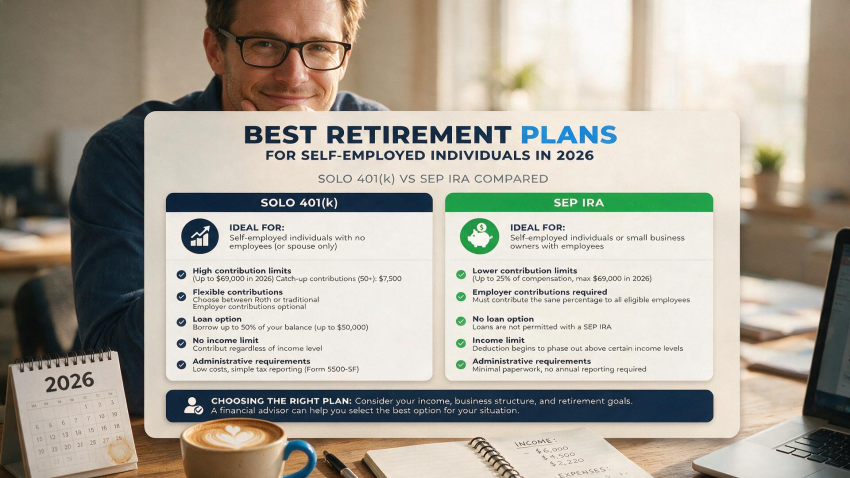
The defining feature of the solo 401(k) is that you wear two hats. As the employee, you can defer up to $24,500 in 2026, which is the same elective deferral limit that applies to corporate 401(k) plans. As the employer, you can add a profit-sharing contribution of up to 25 percent of compensation for an S-corporation owner, or roughly 20 percent of net self-employment earnings for a sole proprietor after accounting for the self-employment tax deduction. Those two contributions stack, which is why a solo 401(k) can allow a self-employed person to save more at a given income level than a SEP IRA can.
The catch-up contribution is where the solo 401(k) pulls further ahead. Savers aged 50 and older can add $8,000 on top of the $24,500 deferral in 2026, and workers aged 60 through 63 can add $11,250 under the SECURE 2.0 “super catch-up” provision. The SEP IRA offers no catch-up at all. For a self-employed person in their fifties or sixties who is trying to maximize savings in the years before retirement, that difference is not a minor detail. It is the difference between a plan that grows with your age and one that does not.
The solo 401(k) also offers a Roth option, which the SEP IRA lacks entirely. That matters for self-employed people who expect to be in a higher tax bracket in retirement or who simply want the flexibility of tax-free withdrawals later. The Roth contributions are made with after-tax dollars, but the growth and qualified withdrawals are tax-free, and there are no required minimum distributions during the account owner’s lifetime. For a freelancer whose income fluctuates, the ability to choose between pre-tax and Roth contributions in different years is a planning tool that the SEP IRA does not provide.
The loan provision is another solo 401(k) advantage that gets overlooked. If the plan document permits it, a solo 401(k) participant can borrow against their account balance, typically up to the lesser of $50,000 or 50 percent of the vested balance. The SEP IRA prohibits loans. For a self-employed person who faces a cash flow crunch and would otherwise rely on high-interest credit cards or a business line of credit, the loan feature can be a meaningful safety valve. It is not a reason to choose the plan on its own, but it is a feature worth knowing about before you need it.
The administrative side is where the solo 401(k) asks for more. The plan must generally be established by December 31 of the tax year, though a sole proprietor can adopt one later if the first-year deferrals are made before the unextended filing deadline. Once the plan balance exceeds $250,000, the owner must file Form 5500 annually, which adds paperwork and potentially the cost of a tax preparer. Those requirements are not onerous for a disciplined solo operator, but they are real, and they are the reason some people choose the simpler path even when the solo 401(k) would allow them to save more.
The SEP IRA and the Virtue of Simplicity
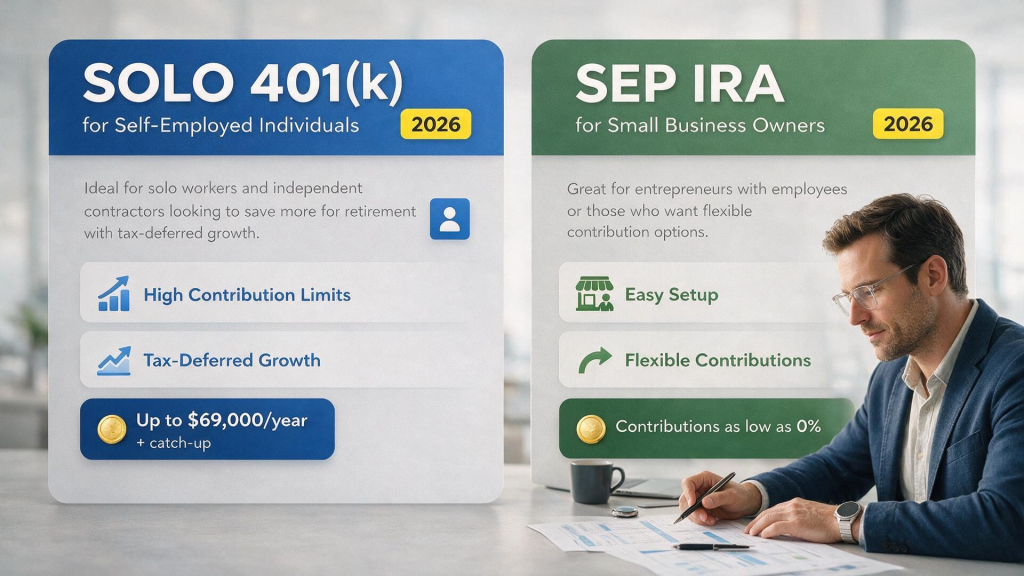
The SEP IRA’s appeal is not that it allows the highest contribution in every scenario. It is that it requires almost no administrative effort and can be established and funded much later than a solo 401(k). The SEP IRA deadline is the business tax return due date, including extensions, which means a self-employed person can open the plan and make the contribution as late as October 15 of the following year if they file for an extension. That flexibility is valuable for people whose income is unpredictable and who may not know until they sit down with their tax preparer how much they can afford to contribute.
The contribution limit is the lesser of 25 percent of compensation or $72,000 in 2026, with compensation counted up to $360,000. For a sole proprietor, the 25 percent works out to roughly 20 percent of net self-employment earnings after the self-employment tax adjustment, which is the same effective rate that applies to the employer portion of a solo 401(k). The difference is that the SEP IRA has no employee deferral component on top. A self-employed person earning $100,000 in net profit could contribute roughly $20,000 to a SEP IRA. The same person could contribute $24,500 as an employee deferral plus roughly $20,000 as an employer contribution to a solo 401(k), for a total of more than $44,000. That gap is the reason the solo 401(k) is almost always the better choice for a solo operator with no employees.
The SEP IRA’s simplicity becomes a liability if you ever hire employees. The plan requires the employer to contribute the same percentage of compensation for every eligible employee that the owner contributes for themselves. A solo operator who hires two or three people and has been contributing 20 percent of their own income to a SEP IRA would be obligated to contribute 20 percent of each employee’s salary as well, which can be a substantial and unexpected cost. The solo 401(k) is designed for businesses with no employees other than the owner and a spouse, so it avoids that problem by definition. If you plan to stay solo, the SEP IRA’s simplicity is a genuine advantage. If there is any chance you will hire, the solo 401(k) is the safer structure.
The SEP IRA does have one advantage that is easy to overlook: it can be established after the tax year ends. A freelancer who has a strong year and wants to reduce their tax bill can open a SEP IRA and fund it before the filing deadline, which is not possible with a solo 401(k) unless the plan was adopted by December 31. For people who are not disciplined about year-end planning, that retroactive option can be the difference between saving something and saving nothing. The Self Employed Tax Planning that works best often involves using the SEP IRA as a fallback when the solo 401(k) deadline has passed, rather than as the primary plan.
Coordinating With a Day Job and Other Accounts
The calculation gets more complicated for people who have a day job with a 401(k) and a side business that generates self-employment income. The employee deferral limit of $24,500 is a personal limit that applies across all 401(k) plans combined, so contributions to a day-job 401(k) reduce the amount that can be deferred into a solo 401(k). The employer contribution limit, however, is separate per unrelated employer, which means a side business can still make profit-sharing contributions to a solo 401(k) even if the owner has maxed out their deferrals at their day job. That distinction is worth understanding, because it allows a high earner with a side hustle to save more than they might expect.
The SEP IRA does not have an employee deferral component, so the coordination issue is simpler. The employer contribution to a SEP IRA is separate from any workplace 401(k) contributions, subject to the overall limits on annual additions to defined contribution plans. For a self-employed person with a day job, the SEP IRA can be a straightforward way to save additional money from the side business without worrying about the deferral limit interaction. The trade-off is that the SEP IRA allows less total savings from the side business income than the solo 401(k) would, because it lacks the employee deferral layer.
There is also the question of the Roth catch-up mandate that takes effect in 2026. Workers whose prior-year FICA wages from their employer exceeded $150,000 must direct their catch-up contributions into a Roth account rather than a pre-tax one. That rule applies to W-2 employees, so it is relevant for self-employed people who also work a day job. For a solo operator with no W-2 wages, the rule does not apply, and the catch-up contribution can be made on a pre-tax basis in the solo 401(k). The details matter, and they are the kind of thing that a tax advisor should review before the contribution is made.
The Decision Framework That Actually Works
The practical rule of thumb that emerges from the mechanics is this: if you are a solo operator with no employees and you want to maximize savings, the solo 401(k) is almost always the better choice. The ability to contribute as both employee and employer, the catch-up contributions, the Roth option, and the loan provision all favor it. The administrative burden is modest, and the deadline can be managed with a calendar reminder. The Solo 401k Contribution Limits 2026 are generous enough that most solo operators will hit the deferral limit before they hit the total ceiling, which means the plan’s advantage is concentrated in the early layers of contribution.
The SEP IRA makes sense in a narrower set of circumstances. If you are a sole proprietor who is not confident you can adopt a plan by December 31, the SEP IRA’s later deadline is a real advantage. If you have a small number of employees and want to offer them a retirement plan without the administrative complexity of a 401(k), the SEP IRA is a reasonable choice, provided you understand the equal-percentage contribution requirement. If you are just starting out and your income is modest, the simplicity of the SEP IRA may be worth the lower contribution ceiling for a year or two. But for the freelancer who is established, profitable, and serious about retirement savings, the solo 401(k) is the plan that extracts the most value from the tax code.
The final consideration is the one that no comparison table captures: the behavioral value of a plan that feels manageable. A solo 401(k) that is opened but never funded because the paperwork felt intimidating is worse than a SEP IRA that is opened, funded, and forgotten. The best plan is the one you will actually use. If the solo 401(k) feels like too much, the SEP IRA is a perfectly respectable fallback. But for most self-employed people who are ready to take retirement savings seriously, the solo 401(k) is the plan that rewards that seriousness with the most generous limits and the most flexibility. The Solo 401k vs SEP IRA comparison is not close in the scenarios that matter most. It is a question of whether the extra effort is worth the extra capacity. For most people, it is.