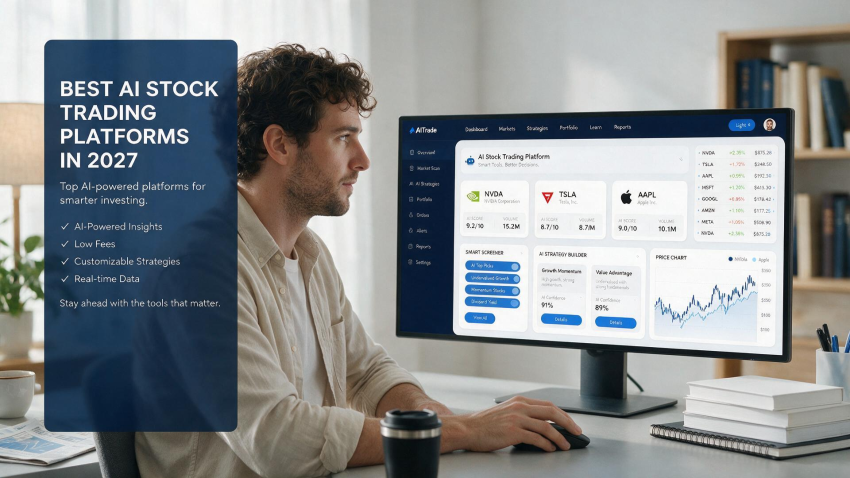
What “AI Trading” Actually Means in 2027—And What It Doesn’t
The phrase “AI stock trading platform” has become one of the most abused marketing terms in finance. Walk through the homepage of any broker or fintech app in late 2026, and you will find the letters A and I plastered across banners promising smarter trades, better timing, and effortless profits. The reality is far messier. Most of what gets labeled AI in retail trading is still traditional automation dressed up in new vocabulary—rule-based bots that execute pre-set instructions, not systems that genuinely learn or reason about markets. The platforms that are actually pushing into artificial intelligence are doing so in narrow, carefully fenced-off ways, and understanding that distinction is the first step toward choosing a best AI stock trading platform 2027 that serves your actual needs rather than a marketing department’s imagination.
The clearest example of genuine AI integration comes from Interactive Brokers, which rolled out IBKR Autonomous Trading in October 2026. The feature allows eligible clients to authorize connected AI platforms—including ChatGPT, Claude, Grok, and Perplexity—to monitor more than 75,000 listed stocks, options, and ETFs, evaluate opportunities against client-defined criteria, and submit supported orders without requiring approval for each individual trade. This is not a trading bot with a fixed set of if-then rules. It is a natural-language interface that lets you describe what you want in plain English, such as “sell 30-day covered calls when a holding’s implied volatility hits its 52-week 90th percentile,” and then lets the AI monitor and execute within those parameters. The critical safeguard is the AI Partition, a dedicated account funded from your main IBKR balance, which limits the damage if something goes wrong. The AI can only touch the money you have explicitly allocated to it, and you retain the ability to define and adjust the instructions it follows.
Robinhood is taking a different approach. After more than 150,000 customers opened accounts for its external AI agent connections, the company announced Robinhood Agents, which will let eligible U.S. customers research markets, build strategies, and place trades without connecting external platforms. The app will allow users to choose an AI model, set trading instructions and limits, and enable manual trade approval by default. A planned Loops feature will let strategies run repeatedly, including overnight, and weekend trading for selected stocks and ETFs is slated for early 2027 pending regulatory review. The philosophy here is accessibility over sophistication. Robinhood is not trying to build the most powerful AI trading system; it is trying to put a usable version of one inside the app that millions of casual investors already have on their phones. Whether that is a good thing for those investors is an open question, but it is undeniably a different product from what a professional-grade platform offers.
For traders who want to build and test their own algorithms rather than rely on a broker’s built-in AI, the landscape includes platforms like cTrader Algo and Freqtrade. cTrader Algo lets developers write bots in C# or Python and run them on a broker-hosted platform, with cloud execution that keeps strategies running even when your computer is off. There is no native AI assistant inside cTrader, but because the languages are mainstream, general-purpose models like ChatGPT and Claude can generate competent first drafts of trading logic that you then paste into the editor and compile. Freqtrade, an open-source Python bot for crypto exchanges, includes FreqAI, a machine learning module that trains models per trading pair and retrains them on a fixed schedule to adapt to changing market conditions. These are not consumer products. They require coding ability, a willingness to debug, and an understanding of how markets actually behave. But for the technically inclined, they offer a level of control that no broker-integrated AI can match.
Comparing Fees and Features Across the Major Platforms
The cost structure of AI-assisted trading is not dramatically different from conventional brokerage, but there are important wrinkles to understand. Interactive Brokers offers two pricing tiers: IBKR Lite, which provides commission-free trading on eligible U.S.-listed stocks and ETFs, and IBKR Pro, which charges per-share pricing for traders who want more control over execution. The AI features themselves do not carry a separate subscription cost, but the Autonomous Trading capability is subject to funding and eligibility limits that may evolve. For active traders who execute frequently, the per-share model can be cheaper than a flat commission, but it requires careful tracking. For long-term investors who trade occasionally, the commission-free tier is almost certainly the better fit.
Robinhood’s pricing remains its core selling point: zero commissions on stock and ETF trades, with revenue generated through payment for order flow and subscription products. The AI Agents feature is being positioned as part of the core app experience rather than a premium add-on, though the company has not ruled out monetizing advanced features through its Gold subscription tier. The trade-off for the low cost is a platform that prioritizes simplicity over depth. Robinhood’s research tools, charting capabilities, and order types are adequate for basic investing but limited compared to what Fidelity, Schwab, or Interactive Brokers offer. If your strategy relies on detailed technical analysis or complex options structures, the AI agent will not compensate for the platform’s analytical shortcomings.
For developers using cTrader Algo, the platform itself is free through any supporting broker, which means the cost is determined by the broker’s commission structure rather than a separate software license. Freqtrade is open-source and free to use, but it requires a server or a dedicated machine to run continuously, and the time cost of maintaining and debugging a self-hosted bot is substantial. Vectorbt, a Python library for backtesting and strategy development, charges $25 per month or $20 per month billed annually, with a lifetime option at $500. These tools are not consumer products in any conventional sense. They are infrastructure for people who treat trading as a technical discipline rather than a casual hobby.
One fee-related consideration that applies across all AI-assisted platforms is the cost of the AI itself. When you connect a third-party model like ChatGPT or Claude to Interactive Brokers through the MCP integration, you are using your own subscription to that model, not a service bundled by the broker. That means the total cost of your AI trading setup includes whatever you pay for access to the underlying language model, which can range from free tiers with usage limits to $20 or more per month for premium access. The broker does not charge extra for the connection, but the AI does not come free either. Factoring that into your overall cost calculation is important, especially if you are running frequent queries or automated monitoring that consumes API credits.
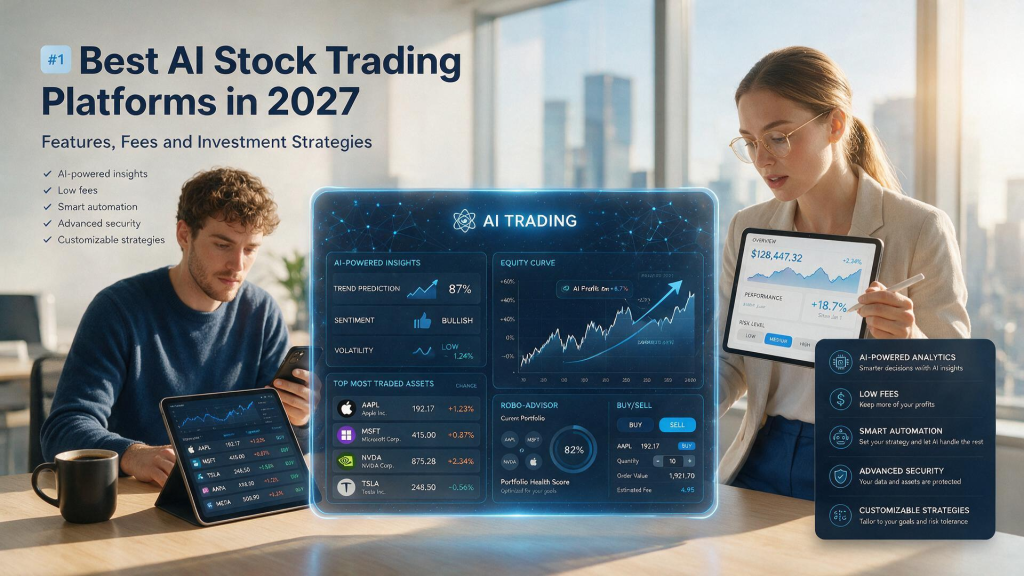
The Risks That AI Trading Platforms Don’t Advertise
The most dangerous misconception about AI trading is that the AI understands what it is doing. It does not. Large language models are pattern-recognition systems trained on text, not financial analysts with a grasp of market microstructure, liquidity dynamics, or the psychological factors that drive short-term price movements. When an AI agent monitors a stock and submits an order based on criteria you defined, it is executing a set of instructions. It is not exercising judgment. The quality of the outcome depends entirely on the quality of the instructions you gave it, and most retail investors are not skilled enough at strategy design to write instructions that perform well across different market conditions.
The paper-to-live gap is another risk that gets almost no attention in the marketing materials. Backtesting a strategy on historical data tells you how it would have performed in the past. It does not tell you how it will perform in the future, and it does not account for the real-world frictions that erode returns: slippage, latency, partial fills, liquidity constraints, and API failures. A strategy that produced impressive simulated returns in a backtest can lose money immediately when deployed with real capital because the market conditions it was optimized for have changed. The platforms that offer paper trading modes are valuable precisely because they let you test the plumbing before you trust it with money. But a profitable paper trading result is not evidence that the strategy works. It is evidence that the simulation ran without errors.
The permission surface is the third risk, and it is the one that determines how much damage an AI agent can do if something goes wrong. A research assistant that reads market data and generates suggestions cannot lose your money. A trading bot with API access to your brokerage account can. A bot with withdrawal permissions can do far worse. The platforms that take this seriously design their AI features with limited permissions by default. Interactive Brokers’ AI Partition is the clearest example: the AI can only access the funds you have explicitly transferred into that partition, and it cannot touch the rest of your account. Robinhood’s manual trade approval default serves a similar purpose, requiring you to confirm each trade before it executes unless you deliberately disable that safeguard. If a platform asks for broad permissions without clear explanations of why they are necessary and how they are limited, that is a reason to walk away.
There is also the question of what happens when the AI is wrong in a way that is difficult to detect. A rule-based bot that executes a simple moving average crossover strategy is transparent. You can look at the code and understand exactly why it bought or sold. An AI agent that monitors dozens of variables and submits orders based on natural-language instructions is not transparent in the same way. If it makes a trade that loses money, you may not be able to reconstruct the reasoning that led to it. That opacity is not necessarily a deal-breaker, but it is a feature that should be understood before you authorize an AI to act on your behalf. The platforms that offer detailed logs and audit trails are preferable to those that do not, because they give you a way to learn from mistakes rather than simply absorbing them.
How to Choose a Platform That Matches Your Actual Trading Style
The right platform depends on what kind of trader you are, not on which one has the most impressive AI features. If you are a long-term investor who buys diversified ETFs every month and rebalances annually, you do not need an AI trading agent. You need a low-cost broker with a clean interface, reliable execution, and good tax reporting. Fidelity and Schwab both fit that description well, and neither will tempt you into using features you do not understand. The AI capabilities on those platforms, where they exist at all, are focused on research and education rather than execution. That is appropriate for the audience.
If you are an active trader who wants to automate parts of your workflow without writing code, Interactive Brokers is the most sophisticated option available. The combination of natural-language instructions, a dedicated AI partition for risk control, and access to more than 75,000 tradable instruments worldwide makes it the closest thing to a professional-grade AI trading environment that a retail investor can access. The learning curve is steep, and the platform is not forgiving of mistakes, but the tools are genuinely powerful. Robinhood is the better choice for someone who wants a taste of AI-assisted trading without the complexity, provided they understand that the simplicity comes at the cost of depth.
If you are a developer who wants to build and test your own strategies, the calculation is different. cTrader Algo and Freqtrade offer the control and flexibility that consumer platforms cannot match, but they require coding skills and a willingness to troubleshoot. The time investment is significant, and the returns are not guaranteed. Many people who start building their own trading bots abandon the project within a few months because the maintenance burden exceeds their interest in the outcome. That is not a failure of the tools; it is a mismatch between the tool and the user. The algorithmic trading community is full of people who spent months optimizing a strategy only to discover that it performed worse than a simple index fund. The honest assessment is that most retail traders do not need algorithmic trading, and the ones who do are usually the ones who already have a deep understanding of markets and a specific problem they are trying to solve.
For the broad middle of investors who are curious about AI but not ready to hand over control, the research-focused tools are the most appropriate starting point. Platforms like Danelfin assign stocks an AI score based on technical, fundamental, and sentiment indicators, giving you a probability estimate rather than a trade recommendation. Prospero.ai offers dark pool and options sentiment data that was previously available only to institutional investors. These tools do not execute trades, which means they cannot lose your money. They inform your decisions, and the responsibility for those decisions remains with you. That is a healthier relationship with AI than the one promised by platforms that offer to trade on your behalf. The best online stock brokers for most people in 2027 are still the ones that give you good tools, low costs, and reliable execution, with AI as a supplement rather than a substitute for your own judgment. The stock trading apps that push autonomous execution as the headline feature are selling a fantasy. The ones that use AI to make you a better-informed investor are selling something more modest but more durable.