
The Question That Gets Harder Every Year
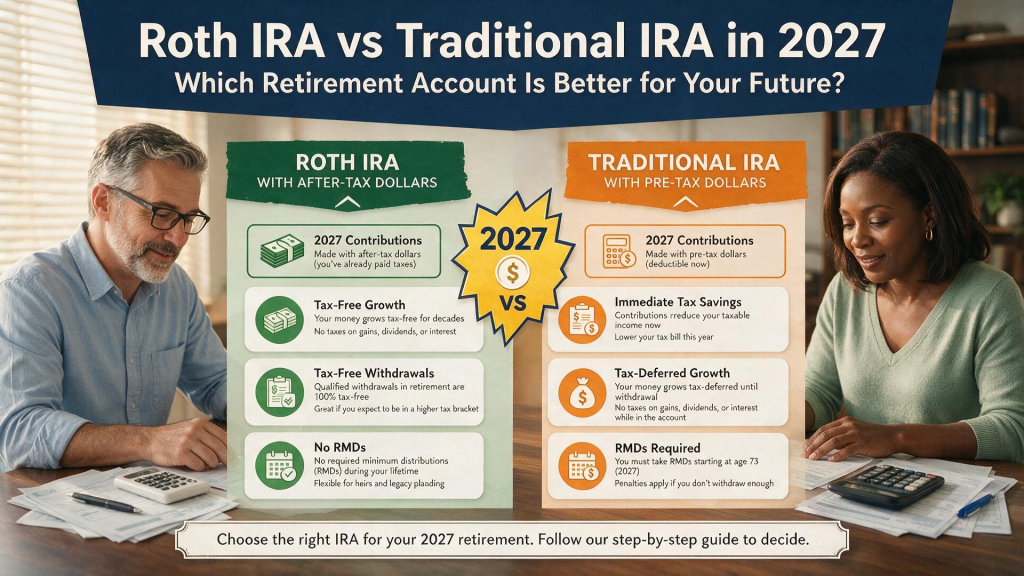
Ask ten financial advisors whether a Roth or a Traditional IRA is the better choice, and you will get ten different answers delivered with varying degrees of confidence. The reason is not that the experts disagree on the mechanics. The mechanics are straightforward: a Traditional IRA gives you a tax deduction today and taxes your withdrawals later, while a Roth IRA gives you no deduction today but lets you withdraw everything tax-free in retirement. The disagreement comes from the fact that the right answer depends entirely on a variable nobody can predict with certainty—what your tax rate will be when you finally tap the account. In 2027, with tax policy in flux and retirement savings rules continuing to evolve, that uncertainty has only grown. Anyone weighing Roth IRA vs Traditional IRA options needs to move past the simplistic “it depends on your bracket” advice and understand the specific factors that will determine which account serves them better over a multi-decade horizon.
The contribution limits for 2027 offer a useful starting point. The IRS has held the annual IRA contribution limit at $7,500 for individuals under fifty, with an additional $1,100 catch-up contribution for those fifty and older, bringing the total to $8,600. That is the same limit as 2026, which means inflation adjustments have paused for the moment. The limit applies across both account types combined, so you cannot contribute $7,500 to a Roth and another $7,500 to a Traditional in the same year unless you are using separate accounts for a spouse. The shared limit is a critical detail because it forces a decision: every dollar you direct to one account is a dollar you cannot direct to the other. That decision has consequences that compound for decades, and it deserves more thought than a quick glance at a tax bracket table.
What makes 2027 particularly interesting is the maturation of the retirement savings landscape. The SECURE 2.0 Act provisions that were phased in over the past several years are now fully operational, and the saver’s match—a federal program that provides a government-funded contribution to eligible low- and moderate-income savers—has replaced the older saver’s credit in a form that is more direct and more valuable. Meanwhile, the income thresholds for Roth eligibility continue to shift with inflation, and the gap between those who can contribute directly to a Roth and those who must use the backdoor conversion strategy has become a source of frustration for higher earners. Understanding where you fall on that spectrum is the first practical step in choosing a best retirement accounts 2027 strategy that actually fits your situation rather than a generic template.
How the Tax Math Actually Works Over a Lifetime
The core argument for a Traditional IRA is simple arithmetic. If you are in a 24 percent federal tax bracket today and expect to be in a 22 percent bracket in retirement, the deduction you receive now is worth more than the tax you will pay later. You contribute $7,500, deduct it from your taxable income, save roughly $1,800 on your current-year tax bill, and then pay 22 percent on withdrawals when you are older. The Roth reverses that: you pay the 24 percent now, contribute $7,500 in after-tax dollars, and withdraw everything tax-free. On paper, the Traditional wins if your bracket drops, and the Roth wins if it rises. But the arithmetic gets more complicated once you factor in the growth of the account, the timing of withdrawals, and the interaction with other income sources like Social Security and required minimum distributions.
Required minimum distributions are the variable that most people overlook, and they tilt the calculation in favor of the Roth for many savers. Traditional IRAs force you to begin withdrawing money at age 73, whether you need the income or not, and those withdrawals are taxed as ordinary income. If you have saved diligently and your Traditional IRA has grown large, the RMDs can push you into a higher bracket in retirement than you occupied during your working years. That is the cruel irony of the Traditional IRA: the deduction you took at 24 percent gets repaid at 32 percent because the account grew so large that the government demands its share in larger chunks than you planned for. Roth IRAs have no RMDs during the original owner’s lifetime, which means the money can continue growing tax-free indefinitely, and you can choose when and how much to withdraw based on your needs rather than the IRS’s schedule.
There is also the matter of what happens to the account after you die. A Traditional IRA inherited by adult children must generally be emptied within ten years, and the distributions are taxable to the heirs at their own tax rates. If your children are in their peak earning years when they inherit, the tax bill can be substantial. A Roth IRA inherited under the same rules still must be emptied within ten years, but the withdrawals are tax-free. That is a meaningful advantage for anyone who views their retirement account as part of their estate plan rather than just a personal savings vehicle. The tax free retirement income that a Roth provides extends beyond your own lifetime, and for parents who want to leave their children with assets that do not come with a hidden tax liability, that feature alone can justify the upfront cost of paying taxes now rather than later.
The Income Limits and the Backdoor Strategy
Roth IRA contributions are subject to income limits that phase out at higher earnings levels. For single filers, the ability to contribute directly to a Roth begins to phase out at a modified adjusted gross income of $153,000 and disappears entirely at $168,000. For married couples filing jointly, the phase-out range is $242,000 to $252,000. These thresholds are adjusted periodically for inflation, but they have not kept pace with wage growth in high-cost professions, which means that a two-income household in a major metropolitan area can easily find itself above the limit even if neither spouse earns an extraordinary salary. If your income exceeds the threshold, you cannot contribute to a Roth IRA directly, and that is where the backdoor Roth strategy enters the picture.
The backdoor approach is straightforward in concept: you contribute to a Traditional IRA, receive no deduction because your income is too high for one, and then convert that contribution to a Roth IRA. The conversion itself is a taxable event only to the extent that the money has grown or that you have other pre-tax funds in Traditional IRAs. If you contribute $7,500 and convert it immediately before any growth occurs, the tax bill is zero because you are converting after-tax dollars. The problem is the pro-rata rule, which treats all of your Traditional IRA balances as a single pool when calculating the tax owed on a conversion. If you have $50,000 sitting in a Traditional IRA from an old 401(k) rollover, and you attempt to convert a new $7,500 after-tax contribution, the IRS does not let you cherry-pick the after-tax dollars. It calculates the taxable portion based on the ratio of pre-tax to after-tax money across all your Traditional IRAs, which means roughly 87 percent of your conversion would be taxable in that scenario.
The workaround is to move any pre-tax Traditional IRA balances into a workplace 401(k) before executing the backdoor conversion. Workplace plans are not counted in the pro-rata calculation, so once the pre-tax money is safely parked in a 401(k), the Traditional IRA contains only after-tax contributions, and the conversion becomes essentially tax-free. This maneuver requires coordination with your employer’s plan administrator and careful timing, because the pro-rata calculation looks at your IRA balance on December 31 of the conversion year, not the date of the conversion itself. If you are considering a Roth IRA benefits strategy and your income is near or above the limit, the backdoor route is worth exploring, but it demands precision. A mistake can create an unexpected tax bill that erodes much of the advantage.
Why Young Earners Should Lean Roth and Late-Career Savers Should Think Twice
The general rule of thumb in the financial planning world is that younger workers in lower tax brackets should favor the Roth, while older workers in their peak earning years should favor the Traditional. The logic is sound. A 25-year-old in the 12 percent bracket who contributes to a Roth is paying a very low tax rate on money that will grow for forty years and come out completely tax-free. The same dollar contributed to a Traditional IRA would generate a modest deduction at 12 percent but would be taxed at whatever rate applies in retirement, which could easily be 22 percent or higher given the trajectory of entitlement spending and federal deficits. For the young earner, the Roth is almost always the better deal because the tax cost of contributing is so low and the growth horizon is so long.
For a 55-year-old in the 32 percent bracket, the calculus flips. The Traditional IRA deduction is worth real money at that rate, and the retiree who draws from the account in their late sixties and early seventies may find themselves in a lower bracket, especially in the window between retirement and the start of Social Security and RMDs. That window—sometimes called the tax valley—is when taxable income can be deliberately managed through partial Roth conversions or strategic withdrawals. A high earner who retires at 62 and delays Social Security to 70 has eight years of unusually low taxable income, and converting Traditional IRA funds to Roth during that period can lock in a lower tax rate on money that would otherwise be taxed at a higher rate when RMDs begin. This is a more sophisticated approach than simply choosing one account type at the outset, and it reflects the reality that most people will benefit from holding both types of accounts and managing the mix over time.
The decision also interacts with your other retirement savings. If you have a 401(k) at work, you are already deferring taxes on those contributions. Adding a Traditional IRA on top of that concentrates your retirement savings in tax-deferred accounts, which means a larger RMD burden later and less flexibility in managing your taxable income. Adding a Roth IRA instead diversifies your tax exposure, giving you a pool of tax-free money that can be accessed strategically to keep your taxable income below thresholds that trigger higher Medicare premiums or the net investment income tax. The retirement investment strategies that work best in practice are rarely pure plays. They are blends, and the blend should shift as your income, age, and tax situation evolve.
Withdrawal Flexibility and the Emergency Fund Angle
One of the most underappreciated features of the Roth IRA is the ability to withdraw your contributions at any time, for any reason, without taxes or penalties. This is not true of earnings—those are subject to the five-year rule and the age 59½ threshold—but the money you put in can come back out whenever you need it. That flexibility makes the Roth a more versatile vehicle than the Traditional for savers who are building both a retirement fund and a safety net. If you contribute $7,500 to a Roth in 2027 and face an unexpected expense in 2029, you can withdraw that $7,500 without penalty, and the growth that occurred in the meantime stays in the account and continues to compound tax-free. A Traditional IRA offers no comparable flexibility; withdrawals before 59½ are generally subject to a 10 percent penalty on top of ordinary income tax, with narrow exceptions for first-time home purchases, qualified education expenses, and certain hardships.
That flexibility comes with a caveat. Retirement accounts should not be treated as emergency funds, because the whole point is to leave the money invested for decades. But life is unpredictable, and the Roth’s contribution withdrawal feature provides a backstop that the Traditional simply does not. For younger savers who are still building their emergency fund and their retirement account simultaneously, the Roth offers a way to do both without locking up every dollar until age 59½. The psychological benefit of knowing the money is accessible can also make people more willing to contribute aggressively, which is ultimately what matters most. A slightly suboptimal account choice that you fund consistently will beat a theoretically perfect choice that you underfund because it feels too restrictive.
The IRA contribution limits 2027 apply equally to both account types, so the $7,500 cap does not change based on which one you choose. What changes is what that $7,500 becomes. In a Roth, it becomes a pool of tax-free money that grows without RMDs and can be passed to heirs without a tax burden. In a Traditional, it becomes a tax deduction today and a taxable withdrawal later, with the outcome depending on future tax rates that no one can predict. The right choice depends on your current bracket, your expected future bracket, your other savings, your estate planning goals, and your tolerance for tax uncertainty. For most people under forty, the Roth is the better starting point. For those in their peak earning years with substantial existing tax-deferred savings, the Traditional deduction may be more valuable. And for everyone, holding both types of accounts and managing the mix strategically over time is the approach that offers the most flexibility when retirement finally arrives.