
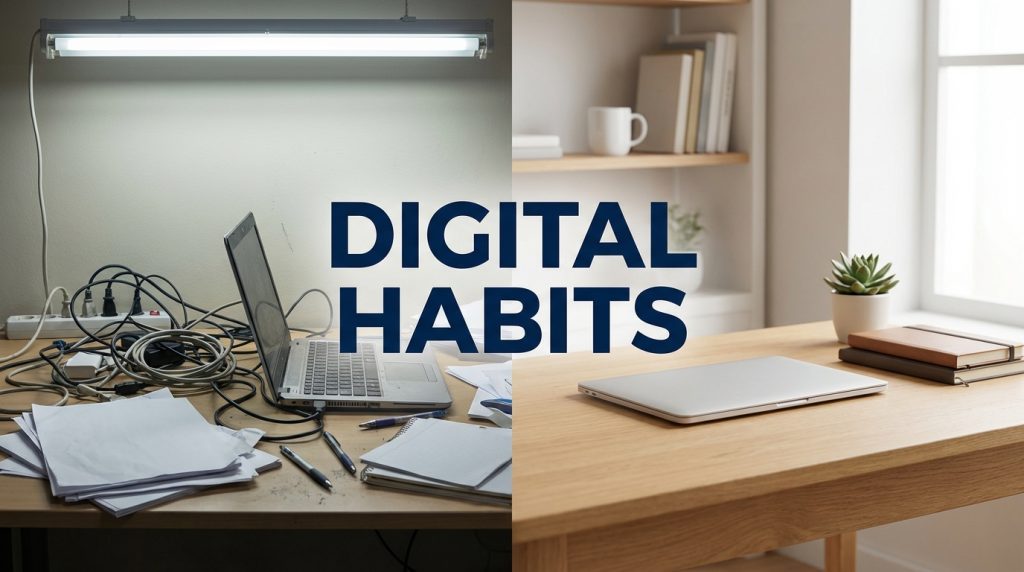

Last spring, I spent an entire Saturday afternoon on what I called a “digital detox day.” I cleaned out my inbox, organized my Google Drive, deleted old apps, unsubscribed from newsletters, and cleared my Downloads folder. By 6 PM, everything was pristine. I felt accomplished. Refreshed, even.
Two weeks later, my inbox had 200 unread messages. My Downloads folder had 40 new files. My Google Drive had a fresh collection of unsorted documents floating outside any folder. The entire cleanup had evaporated, and I was back to square one.
This pattern — purge, feel good, slide back, purge again — is so common that it has become the default way most people deal with digital clutter. And it does not work. Not because the cleaning itself is bad, but because the cleaning addresses the symptom without touching the cause.
The Purge Cycle: Why It Feels Good But Fails
A big cleanup session triggers a real psychological reward. You are making visible progress. You can see the unread count dropping, the folders getting organized, the storage space freeing up. It feels productive. Your brain associates the activity with accomplishment.
But here is the problem: the systems that created the clutter are still running. You are still subscribed to newsletters you do not read. You are still saving files to the default Downloads folder without naming them. You are still using your inbox as a to-do list instead of a communication tool.

A purge is like mopping the floor while the faucet is still running. It looks clean for a moment, but the water keeps coming.
| Approach | Time Investment | Lasting Impact | Why It Fails or Succeeds |
| Weekend purge | 2-4 hours, once every few months | Low — results erode within 2-3 weeks | Addresses the pile, not the habits creating it |
| Daily micro-habits | 5-10 minutes per day | High — prevents accumulation entirely | Maintains order continuously with minimal effort |
| Combination | One initial purge + daily habits | Highest — clean start with sustained maintenance | Resolves existing mess and prevents recurrence |
The Shift: From Event to Habit
The alternative to periodic purges is building tiny daily habits that prevent clutter from accumulating in the first place. This is less dramatic, less satisfying in the short term, and significantly more effective in the long term.
I now spend about eight minutes a day on digital maintenance, broken into three micro-tasks:
Morning: The Two-Minute Inbox Scan (Before Deep Work)

Before I start my first real task, I spend two minutes on my inbox. Not responding to emails — just scanning. I delete obvious junk, archive anything that requires no action, and flag the two or three messages that need a real response later. The goal is to get the unread count to single digits so my inbox does not nag at me all morning.
Midday: The One-Minute File Sweep
After lunch, I glance at my Downloads folder and desktop. If any new files have landed there, I either move them to their correct folder immediately or delete them. This takes about 60 seconds and prevents the slow buildup that leads to weekend purge sessions.
End of Day: The Five-Minute Shutdown Ritual
Before closing my laptop, I spend five minutes on a shutdown ritual. I close all open browser tabs (or save the truly important ones to a note — not a bookmark). I clear my desktop of any files I worked on. I review my task list for tomorrow. Then I close the laptop.
This ritual does two things. First, it maintains digital order without requiring a dedicated session. Second, it creates a psychological boundary between work time and personal time — my shutdown ritual signals to my brain that the workday is over.
Why Five Minutes a Day Beats Four Hours a Month
The math here is straightforward. Five minutes per weekday is roughly 100 minutes per month — about 1.5 hours of total maintenance time. A quarterly purge takes 3 to 4 hours and delivers results that fade within weeks.
But the real advantage is not time savings. It is cognitive load. When your digital environment stays clean continuously, you never reach the point where the mess becomes stressful. You never open your inbox on Monday and see 200 unread messages. You never search for a file in a chaotic folder for ten minutes. You never feel the sinking “I need to deal with this” dread that triggers purge sessions in the first place.
How to Build the Habit Without Overthinking It
Habit formation research consistently shows that new habits stick better when they are attached to existing behaviors. This is called “habit stacking” — linking a new behavior to something you already do automatically.
- Already check email first thing? Add the two-minute sort before you respond to anything.
- Already eat lunch at your desk? Add the one-minute file sweep right after eating.
- Already shut your laptop at the end of the day? Add the five-minute cleanup before closing it.

The habit does not need to be perfect. If you skip the midday sweep, your system does not collapse. If you do a sloppy shutdown ritual one evening, the damage is one or two unsorted files — not an avalanche. The system is resilient because it runs every day, not because each individual session is thorough.
What About the Initial Mess?
If your digital environment is currently in bad shape, you will need one initial cleanup session. I am not saying purges are useless — I am saying they are a starting point, not a strategy.
Do one purge to get to a clean baseline. Then switch to the daily micro-habit system to maintain it. The purge clears the backlog. The habits prevent a new one from forming.
Think of it like brushing your teeth. You might occasionally need a dental cleaning (the purge), but the reason your teeth stay healthy is the daily brushing (the habit). Nobody brushes their teeth only once every three months and expects good results.
Tracking Whether It Is Working
After a month of daily maintenance habits, check these three indicators:
| Indicator | Before Daily Habits | After One Month |
| Inbox unread count at end of day | 50-200+ | Under 10 |
| Files in Downloads folder | 100+ | Under 15 |
| Time spent searching for files per week | 1-2 hours | Under 15 minutes |
If you are not seeing improvement, the likely problem is that one of the three daily tasks is being skipped consistently. It is almost always the end-of-day shutdown ritual — it is the longest one and the easiest to skip when you are tired. If that is the case, shorten it. Even two minutes of cleanup is better than zero.
The Point Is Sustainability, Not Perfection
Perfection is not the goal. The goal is a system that keeps your digital life at a manageable level without requiring dedicated blocks of time. A few stray files in your Downloads folder are fine. An inbox with 15 unread messages is fine. What is not fine is the slow accumulation that turns manageability into overwhelm over weeks and months.
The purge makes you feel productive for a day. The habit makes you stay organized for a year. I will take the second one every time.