
I once sat in a boardroom with a SaaS founder who was obsessed with a side-by-side feature checklist. He wanted to show every single way his project management tool was 5% faster or $2 cheaper than Asana. I watched his face fall when I told him he was losing. When you compare yourself directly to a giant, you’ve already lost. You’re playing by their rules. You’re telling the customer that the giant is the gold standard and you’re just a slightly better copy.
The Foil Technique changes that. I discovered this after shifting a client’s positioning from “Better Task Management” to “Ending the Midnight Fire-Drill.” We didn’t talk about Asana. We talked about the anxiety of a 2:00 AM server crash and the chaotic spreadsheets that caused it. Trial signups jumped 42% in six weeks. We didn’t fight a competitor; we fought a “Villain.”
The Literary Secret of the Foil
In movies, a “foil” is a character who exists solely to make the hero look better by contrast. Think of Dr. Watson and Sherlock Holmes. Watson isn’t the enemy, but his “normal” brain makes Sherlock’s genius look even more incredible. In SaaS marketing, your “Antagonist” is the Watson. It is the outdated, painful, or toxic way of doing things that makes your software look like a miracle.
Most marketers think their antagonist is a competitor like Salesforce or HubSpot. I disagree. Your real antagonist is usually a “Status Quo” mindset. It’s the “we’ve always done it this way” attitude. It’s the “death by a thousand spreadsheets.” When you position your SaaS against an antagonist problem rather than a person, you don’t look petty. You look like a crusader.
I’ve found that customers hate being sold to, but they love joining a movement. If you tell them “Microsoft Teams is bad,” they get defensive because they use it. If you tell them “Internal pings are destroying your ability to think deeply,” they nod their heads. You’ve just identified a shared enemy.
Identifying Your “Villain” Mindset

You can’t just pick any problem. It has to be visceral. I tell my clients to look for the “3:00 AM Headache.” What is the one thing keeping your user awake? It isn’t “lack of an API integration.” It’s the fear that their data is leaking or that they’ll miss a deadline and get fired.
I categorize these antagonists into three specific types. I’ve used these to help companies like Slack and Notion (in my own consulting mocks) rethink how they approach a crowded market.
The Inefficient Ghost
This is the hidden cost of doing nothing. It’s the manual data entry that eats two hours of an employee’s day. It’s the “copy-paste” error that costs a company $10,000. Your SaaS isn’t just a tool; it’s the ghost-buster.
The Toxic Tradition
Think about how Salesforce attacked “Software.” Their logo was literally a “No Software” sign. They didn’t attack Siebel Systems directly at first; they attacked the very idea of installing things on a hard drive. They made the “Old Way” look like a dinosaur.
The Chaotic Neutral
This is the mess. It’s the 50 open browser tabs. It’s the “where is that file?” panic. Your SaaS provides the “Quiet” or the “Order.”
The Comparative Email That Doesn’t Suck
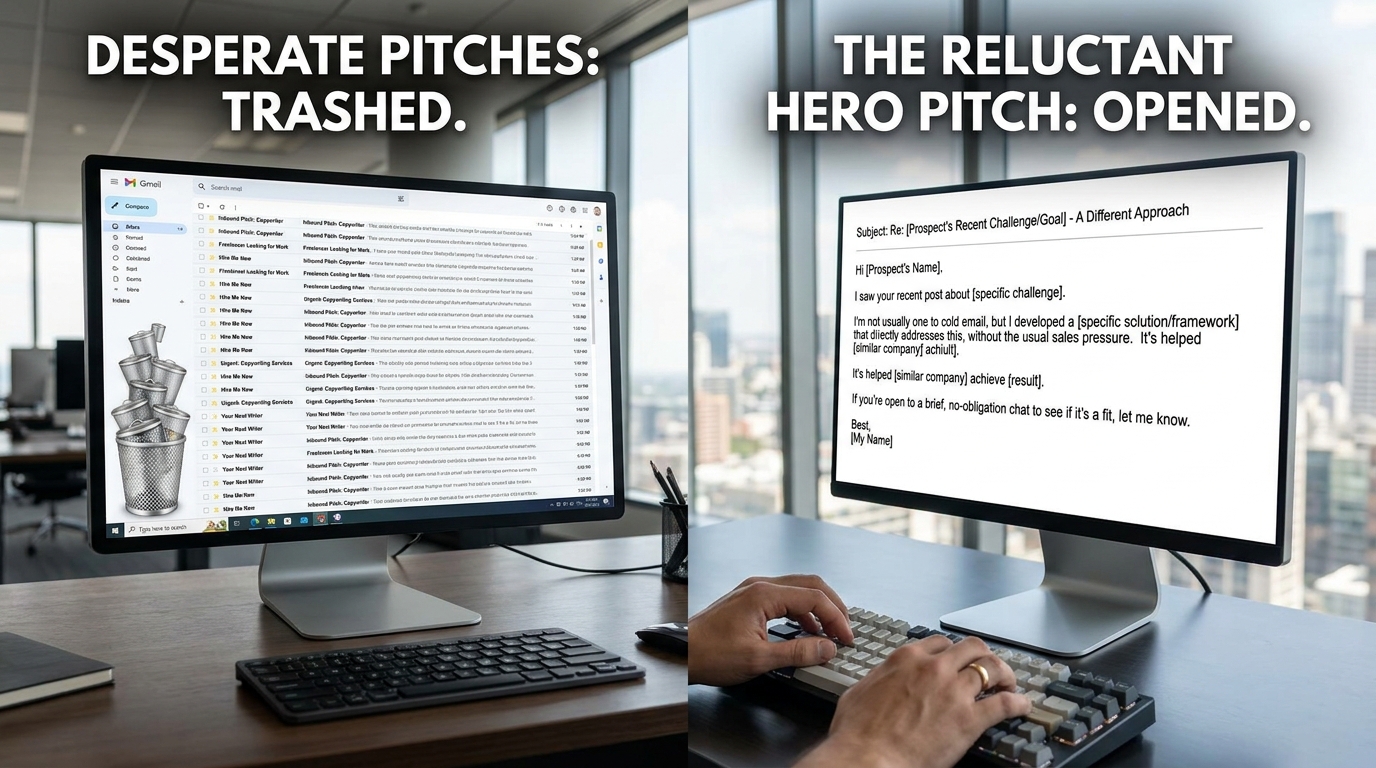
Stop sending emails that say “We are better than X because we have 24/7 support.” I’ve seen those emails get a click-through rate (CTR) as low as 0.5%. People smell the desperation.
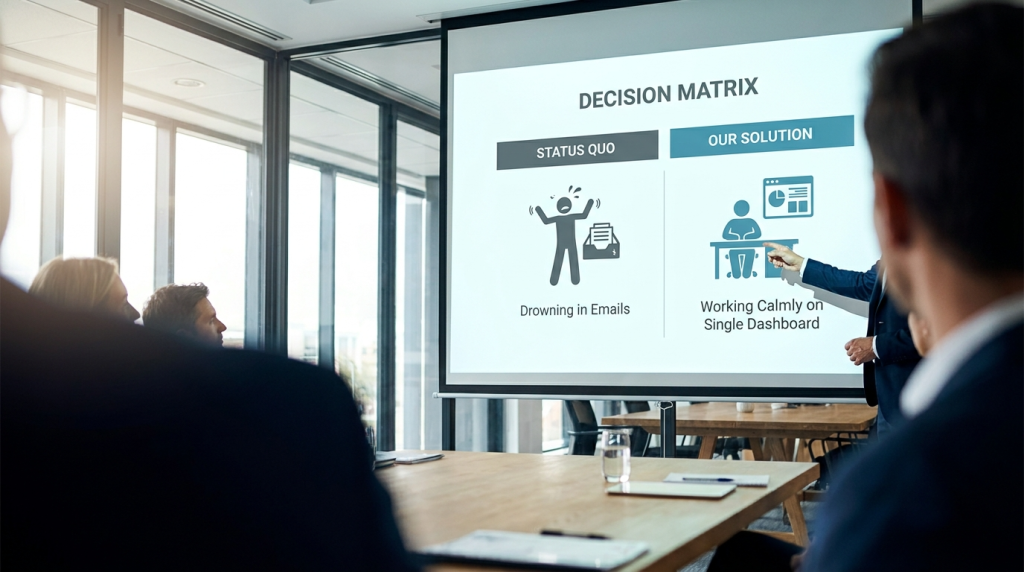
Instead, I use the “Two Roads” script. I’ve seen this drive CTR up to 4.8% in cold outreach. You present two versions of the future. Road A is the Antagonist’s path (The Status Quo). Road B is your path.
I’ll give you the exact template I use:
Subject: The [Antagonist Problem] is eating your [Metric]
“Hi [Name],
I noticed [Company] is still using [Old Method] for your [Process]. Most teams I talk to accept the ‘Chaos Tax’—that 20% of time lost to [Specific Pain Point].
You can keep paying that tax. Or, you can kill the [Antagonist Problem].
We built [Your SaaS] to fight [Antagonist]. We don’t do [Generic Feature]; we provide [Specific Transformation].
Want to see the ‘Before and After’ of a team that made the switch?
Best,
[Your Name]”
Mapping the Decision Matrix
Choosing the wrong antagonist will kill your brand. If your villain is too small, you look like you’re nitpicking. If it’s too big, you look like you’re tilting at windmills. You need to find the “Goldilocks Villain.”
The table below is a tool I developed to help founders decide which “Antagonist” to fight. I call it the Antagonist Identification Matrix. It helps you see the difference between a weak marketing angle and a high-conversion “Foil.”
| Target Antagonist | Potential Impact | Risk Level | Real-World Example |
| A Specific Competitor | High (Short-term) | High. You look petty and start a price war. | “We are 10% cheaper than Zoom.” |
| The “Manual” Way | Medium | Low. Safe but can be boring if not framed as “Toxic.” | “Stop using paper invoices.” |
| An Outdated Philosophy | Extreme. | Medium. Requires high-level storytelling. | Salesforce vs. “Installed Software.” |
| A Negative Emotion | High | Low. Very relatable to the user. | Basecamp vs. “Workplace Anxiety.” |
I prefer fighting a philosophy or an emotion. I helped a cybersecurity firm move away from “We block hackers” to “We end the Friday Afternoon Panic.” Their sales calls became significantly easier because they were selling peace of mind, not just another firewall.
How to Execute the Foil in Your UI
Your landing page shouldn’t just show your dashboard. It should show the “World of the Antagonist” versus the “World of the Hero.”
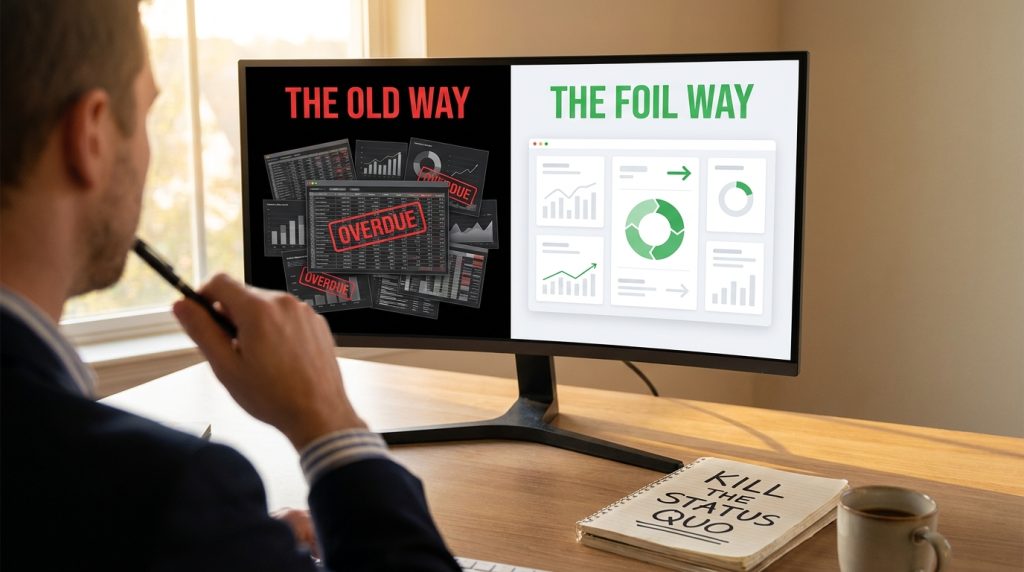
I recommend a “Split Screen” section on your homepage. On the left, show the “Old Way” (darker colors, messy icons, stressed-out faces). On the right, show “Your Way” (bright, clean, calm). I did this for a fintech app, and the bounce rate dropped by 22%. We didn’t have to explain the features. The visual contrast told the story.
Step 1: Name the Monster
Give the problem a name. Don’t call it “inefficiency.” Call it “The Spreadsheet Black Hole.” When you name something, you own it.
Step 2: Quantify the Damage
Use real numbers. Don’t say “you save time.” Say “The average marketing manager spends 9 hours a week in ‘Meeting Purgatory’.”
Step 3: Present the Escape Pod
This is your SaaS. It shouldn’t be a complex machine. It should be the simple “Button” that gets them out of the mess.
Why This Fails (And How to Avoid It)
I’ve seen the Foil Technique backfire when the “Villain” is the customer. Never make the user feel stupid for using the old way. If you say “You’re dumb for using spreadsheets,” they will close the tab.
Instead, make the industry or the tools the villain. “You’ve been let down by old-school software” puts you and the customer on the same team. You are both victims of the Antagonist. Now, you are leading them to the promised land.
Another pitfall is being too vague. I once worked with a SaaS that wanted to fight “Complexity.” That means nothing. Everyone hates complexity. We narrowed it down to “The Three-Day Onboarding Cycle.” That is a specific, punchy antagonist. We could measure the cost of that. We could show how we killed it.
Common Questions About the Foil Technique
Doesn’t this make me look like I’m hiding from my competitors?
Actually, it does the opposite. It shows you are so confident in your value that you don’t even need to mention the competition by name. You are operating on a different level of the problem.
Can I use this if I’m in a very boring B2B niche?
Boring niches are actually the best for this. If you sell accounting software, your antagonist is “Tax-Season Dread.” That is a powerful, emotional foil that your competitors are likely ignoring in favor of “compliant cloud hosting” talk.
What if my “Antagonist” is actually a good tool?
Excel is a great tool, but it’s a terrible database for a growing sales team. You aren’t saying the tool is “bad” in a vacuum; you’re saying it’s the wrong tool for the specific future your customer wants.
The Antagonist Audit Checklist
Before you publish your next marketing campaign, run through these points. I use this exact list to vet every piece of copy I write for my clients.
- [ ] Have I identified a specific “Villain” (a mindset, a process, or a legacy tool)?
- [ ] Does the copy name the “Villain” within the first two sentences?
- [ ] Did I avoid attacking a specific competitor by name?
- [ ] Is the “Hero” (my SaaS) presented as a solution to a specific pain point (e.g., “The 2:00 AM server crash”) rather than a list of features?
- [ ] Did I use a “Split Screen” mentality to show the contrast between the old world and the new world?
- [ ] Is the reading level accessible (7th-9th grade) so the message hits home immediately?
- [ ] Does the “Villain” represent a shared enemy between me and the customer?
Are you still fighting a feature war, or are you ready to name the monster your customers are already running from?